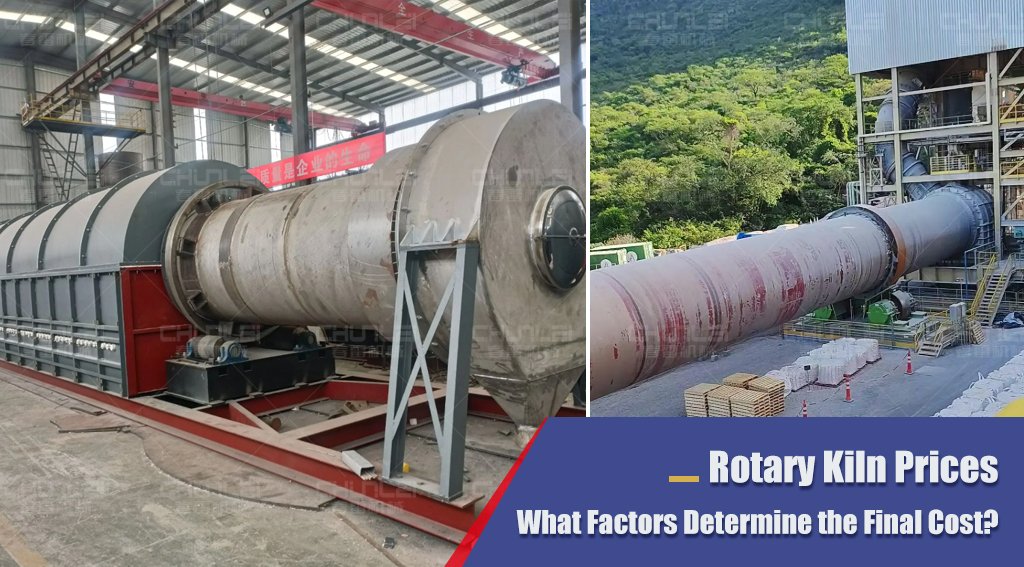
If you inquire about the price of a rotary kiln, you may receive varying quotes—sometimes with significant differences. It is crucial to understand exactly what is included in these quotes; equipment that appears similar in size can ultimately differ greatly in price. A rotary kiln is not a standardized piece of equipment that can be priced simply based on “diameter × length.”
The factors that truly determine the final cost include the heat required for your material, the processing tonnage, the operating temperature, the material’s residence time inside the kiln, and the need for auxiliary systems such as preheating, cooling, dust removal, and automatic controls. Furthermore, the kiln’s dimensions must be engineered based on material properties, gas volume, processing capacity, and specific process conditions, rather than simply selecting a fixed, off-the-shelf model.
Therefore, you should first clarify exactly what the quote covers and whether the equipment meets your specific process requirements.
What does the price of a rotary kiln include?
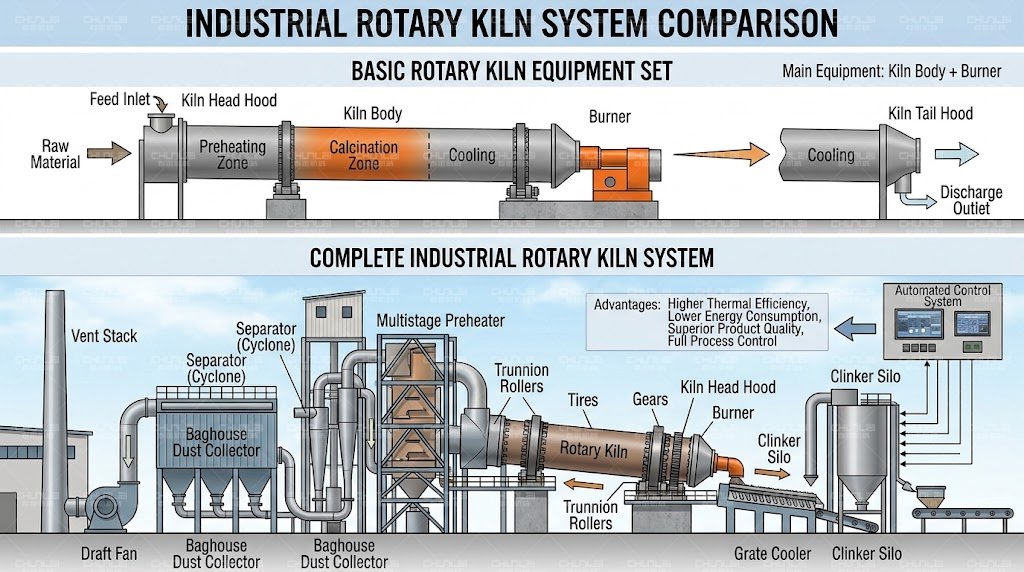
First, it is important to distinguish whether you are comparing the price of the kiln equipment itself or the price of a complete rotary kiln system.
Basic rotary kiln equipment typically includes:
Kiln shell
Riding rings
Support rollers
Drive system
Refractory lining
Feed and discharge components
Burner system
In contrast, a complete thermal processing system may also include:
Preheater
Cooler
Burner and fuel system
Exhaust fan
Dust collector
Gas ducting
Feeding system
Discharge system
PLC/automation system
Temperature and pressure instrumentation
Installation and commissioning
Therefore, even if two quotations both list “rotary kiln,” the actual scope of equipment included may differ significantly.
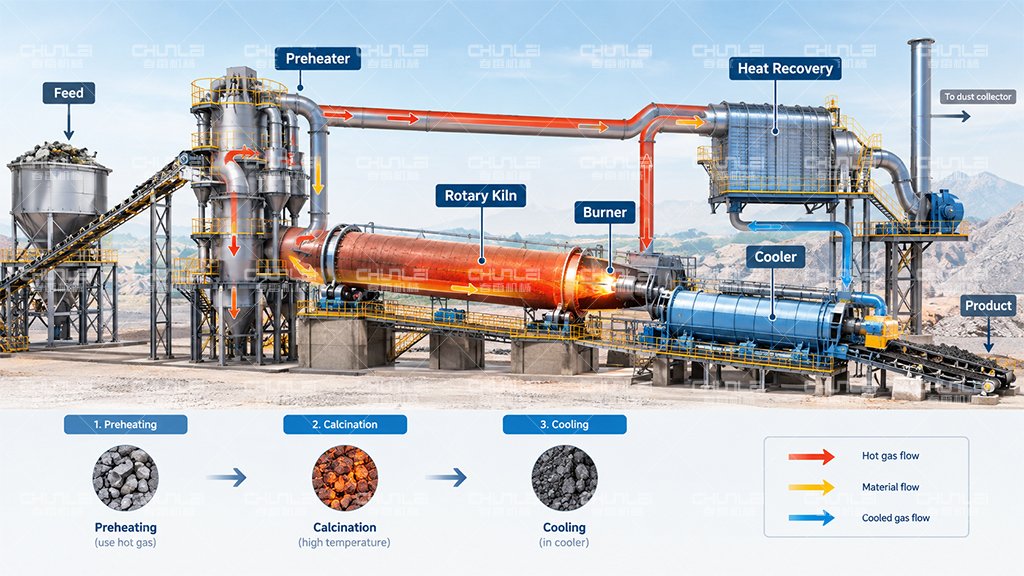
For a complete calcination system, the thermal equipment must be considered alongside combustion, dust removal, heat recovery, cooling, material handling, and control systems, rather than simply accounting for the kiln body alone.
8 Key Factors Determining Rotary Kiln Prices
The price of a rotary kiln is not determined simply by the size of the equipment. Actual price quotes are typically based on a comprehensive assessment of processing capacity, material properties, temperature requirements, the thermal system, and the level of configuration. In particular, since materials and calcination processes vary across projects, the final equipment price can differ significantly even if the processing capacity is the same.
Influencing Factors
Specific Aspects to Consider
Impact on Price
1. Processing Capacity
t/d、t/h
Higher output usually requires a larger kiln body and higher thermal load, increasing equipment and ancillary costs.
2.Rotary Kiln Dimensions
Diameter, length, length-to-diameter ratio
Larger dimensions generally result in higher costs for steel, refractory materials, drive systems, and manufacturing.
Different materials dictate specific requirements for kiln structure, thermal load, and refractory materials.
4. Calcination Temperature
Operating temperature, temperature profile
Higher temperature requirements necessitate more advanced burners, refractory linings, insulation, and control systems.
5. Fuel and Combustion System
Coal, natural gas, diesel, etc.
Different fuels require matching burners, fuel supply systems, and control systems.
6. Refractory Materials
Refractory bricks, castables, wear-resistant layers, etc.
High temperatures or abrasive/corrosive materials may require higher-grade refractory materials.
7. Ancillary Equipment
Preheaters, coolers, dust collectors, fans, etc.
Transitioning from a standalone unit to a complete thermal processing system significantly increases the total investment.
8. Automation and Services
PLC, temperature monitoring, automatic control, installation and commissioning
Higher levels of automation and more extensive after-sales service typically result in higher initial procurement costs.
What should you really look at when comparing rotary kiln prices?
Don’t just compare the “Rotary Kiln Price” on the quote; verify whether the price includes:
Kiln body + Burner + Refractory materials + Feeding system + Discharge system + Preheater + Cooler + Dust removal system + Control system
Some quotes may appear cheaper simply because the scope of the configuration differs.
In short:
Rotary Kiln Price = Equipment scale + Material characteristics + Thermal requirements + Auxiliary systems + Automation configuration.
For long-term projects, it is also advisable to consider fuel consumption, refractory replacement, maintenance costs, and equipment lifespan, rather than focusing solely on the initial purchase price.
Why doesn’t production capacity directly determine the price?
Because production capacity is merely one factor influencing the size and basic configuration of the rotary kiln; it does not reflect the cost of the entire equipment system. For instance, consider two projects with the same 1,000 t/d capacity: one processes material with low moisture content that is easy to calcine, while the other handles material with high moisture content that is difficult to calcine. The latter may require a higher thermal load, higher-grade refractory materials, and more complex combustion, preheating, and cooling systems, resulting in a significantly different final price.
Factor
Impact on Price
Production Capacity
Determines the equipment’s physical dimensions and processing capacity
Material Properties
Moisture content, particle size, density, and abrasiveness influence equipment design
Calcination Temperature
Higher temperatures impose stricter requirements on the combustion system and refractory materials
Fuel System
Coal, natural gas, diesel, etc., require different combustion and fuel-feeding configurations
Thermal System
Inclusion of preheaters, coolers, waste heat recovery systems, etc.
Refractory Materials
Different temperatures and material conditions require different grades of refractory lining
Level of Automation
PLC systems, temperature monitoring, automatic controls, etc., increase configuration costs
Auxiliary Equipment
Inclusion of dust collection, fans, conveying systems, feeders, etc., in the quotation
Production capacity determines the basic scale of the rotary kiln, but the material properties and thermal processes determine how well the equipment needs to be. This is why the prices of rotary kilns with the same production capacity may still vary greatly.
Comparing Rotary Kiln Prices: Individual Equipment vs. Complete Systems
When inquiring about rotary kilns, customers often encounter a common issue: why do price quotes from different manufacturers vary so significantly?
Often, the price difference is not due to the cost of the equipment itself, but rather the scope of the quote. One manufacturer might quote only the rotary kiln unit, while another includes a complete system comprising the combustion system, feeding, preheating, cooling, dust removal, and automatic control units. Therefore, a lower quote does not necessarily mean the equipment is cheaper. If components such as burners, coolers, dust collectors, refractory materials, and control systems must be purchased separately later, the final project investment could increase substantially.
When comparing rotary kiln prices, it is best to ask suppliers to clearly itemize the equipment scope, auxiliary equipment, technical specifications, installation and commissioning details, and service offerings. You should then compare the total project cost rather than focusing on a single figure in the quotation.
In short: when comparing rotary kiln prices, you should compare the total cost based on identical configurations, processes, and scopes of supply.
How does fuel efficiency affect actual costs?
The actual cost of a rotary kiln extends beyond the initial purchase price; fuel consumption is often the decisive factor in long-term operating costs. Low thermal efficiency necessitates higher fuel consumption to achieve the same calcination results; the longer the operation and the higher the output, the more significant the cumulative cost difference becomes.
Key factors influencing fuel efficiency include:
Material moisture content: Higher moisture levels require additional heat for evaporation.
Combustion efficiency: Incomplete combustion wastes fuel and destabilizes the temperature inside the kiln.
Heat utilization rate: Preheaters, coolers, and waste heat recovery systems impact the efficiency of heat utilization.
Kiln insulation performance: Poor performance of refractory materials and insulation layers increases heat loss.
Material particle size: Excessively large particles can lead to inadequate internal heating and reaction, requiring a longer residence time.
Operational parameters: Feed rate, kiln speed, temperature, and airflow must be properly balanced to avoid overheating or insufficient heat.
Therefore, when comparing rotary kiln prices, one should not focus solely on the initial equipment investment. Instead, greater attention should be paid to fuel consumption per unit of product, product quality, and long-term operating costs.
Refractory Lining: A Small Component with a Big Impact on Long-Term Costs
Refractory materials are often overlooked by customers, yet they are closely linked to the long-term operating costs of a rotary kiln.
The refractory lining serves several key functions:
Protecting the kiln shell
Reducing heat loss
Withstanding high temperatures
Resisting abrasion
Resisting chemical attack
If the processed material is highly abrasive or corrosive, the requirements for the refractory material become more demanding.
Therefore, when purchasing equipment, it is essential to clarify this question: “Why is this specific refractory material suitable for my materials and operating temperatures?”
How do you compare rotary kiln price quotes?
When comparing quotes for rotary kilns, do not focus solely on the total price; instead, first verify whether the scope of equipment and technical specifications offered by the two suppliers are consistent. Even for a “1,000 t/d rotary kiln,” the quotes are not directly comparable if one includes only the kiln shell while the other includes the burner, preheater, cooler, and dust removal system.
Comparison Item
Key Aspects to Consider
Processing Capacity
Are the throughput rates (t/d or t/h) comparable?
Material Conditions
Are specifications regarding moisture content, particle size, density, and abrasiveness based on the same conditions?
Rotary Kiln Specifications
Do parameters such as diameter, length, rotational speed, and inclination angle match?
Operating Temperature
Do the design temperature and actual calcination temperature align?
Combustion System
Are the burner, fuel type, and fuel supply system included?
Refractory Materials
Are refractory bricks, castables, and related installation work included?
Auxiliary Equipment
Are the preheater, cooler, dust collector, fans, and conveying equipment included?
Automation System
Configuration of PLC, temperature monitoring, automatic control systems, etc.
Installation and Commissioning
Are installation guidance, commissioning, and technical services included?
After-sales and Spare Parts
Scope of supply for wear parts and spare parts, as well as technical support.
Some low price quotes may appear attractive, but the subsequent need to procure burners, refractory materials, coolers, dust collection equipment, and control systems means the total project investment might not actually be low. Therefore, a more rational approach to comparison is: Rotary kiln price → Scope of configuration → Total line investment → Energy consumption → Maintenance costs → Final operating costs When purchasing, it is best to request a detailed technical specification sheet and Scope of Supply from the supplier—clearly outlining which items of equipment are included—before comparing quotes.
Common Mistakes When Purchasing a Rotary Kiln
Mistake 1: Asking only for the price of the kiln itself Without providing details on the material, production capacity, and temperature requirements, the quote received is often merely a reference figure rather than a final, project-specific solution.
Mistake 2: Comparing only the price of the kiln shell Overlooking components such as the burner, refractory lining, cooler, preheater, dust collection system, and control system makes it easy to underestimate the total project investment.
Mistake 3: Focusing solely on the equipment purchase price Ignoring factors like fuel consumption, refractory lifespan, and maintenance costs can lead to higher long-term operating expenses.
Mistake 4: Assuming “bigger is better” Rotary kiln dimensions must be determined based on processing capacity, material properties, gas flow rates, and residence time; a larger size is not necessarily advantageous.
Mistake 5: Choosing under-equipped machinery for the sake of a lower price If the combustion system, refractory lining, or control system does not match actual operating conditions, the cost of subsequent modifications may exceed the savings achieved during the initial purchase.
FAQ
Q: How much does a rotary kiln cost? A: There is no single fixed price applicable to all projects. The final cost depends on factors such as processing capacity, material properties, kiln dimensions, temperature requirements, the fuel system, refractory materials, and whether auxiliary equipment—such as preheaters, coolers, and dust collection systems—is included.
Q: What is the biggest factor affecting rotary kiln price? A: Generally, processing capacity and process requirements must be considered together. Processing capacity dictates the scale of the equipment, while material properties and target temperatures influence the thermal load, kiln design, combustion system, and refractory materials.
Q: Is a bigger rotary kiln always more expensive? A: While increasing the equipment scale typically leads to higher manufacturing and auxiliary costs, the final price cannot be determined solely by size. Kiln diameter and length must be determined based on processing capacity, gas flow rate, residence time, and material characteristics.
Q: Does fuel type affect rotary kiln cost? A: Yes. Different fuels require specific burners, fuel supply systems, and control systems. Additionally, fuel prices and combustion efficiency impact long-term operating costs.
Q: How can I get an accurate rotary kiln quotation? A: It is best to provide details such as the material name, processing capacity, moisture content, feed particle size, target temperature, product specifications, fuel type, and whether a complete auxiliary system is required. For complex materials, conducting necessary process tests can also help determine the appropriate equipment design.
Summary
When considering the price of a rotary kiln, you cannot look solely at the equipment size; for the same production capacity, quotes can vary significantly depending on the materials, operating temperatures, fuel types, and system configurations.
Therefore, when comparing prices, do not focus only on the initial purchase cost; you should also consider:
Equipment Price + Fuel Consumption + Maintenance Costs + Service Life
For long-term operations in particular, a lower initial price does not necessarily mean lower operating costs down the line.
If you already have details regarding the materials, processing capacity, and calcination temperature, please share these parameters with us. We can then recommend a rotary kiln configuration tailored to your process requirements and provide a more meaningful price quote. Now contact us!
Adjusting the flue gas control ratio of lime kiln rotary kiln (usually refers to the ratio of key components in the flue gas, such as O₂, CO, NOx, SO₂, etc.) needs to take into account the combustion efficiency, environmental protection requireme...
Many cement plants undoubtedly face a common challenge: frequent downtime caused by damaged refractory materials. You are surely well aware that the rotary kiln lies at the very heart of the entire production process. It is within this vessel tha...
Sand is a fine-grained material of small minerals or rock fragments, mainly formed by rock weathering or mineral fragmentation, with grain sizes usually ranging from 0.0625 mm to 2 mm (according to the international standard ISO 14688). Sand can...
When selecting a rotary kiln, many customers view it simply as a large heating cylinder without fully understanding its operating mechanism. In reality, the basic principle is straightforward.Raw materials enter the kiln at the higher end, while ...
 Chunlei Rotary kiln