A rotary kiln may appear to be operating normally, yet it could still be wasting fuel. Excessive exhaust gas temperatures, air leakage, damaged refractory materials, or unstable combustion can all lead to significant heat loss. Over time, this drives up fuel costs and negatively impacts both production efficiency and product quality.
Improving the thermal efficiency of a rotary kiln requires more than just adding more fuel or raising the temperature. The key is to identify exactly where heat is being lost, and then implement targeted improvements in areas such as combustion, heat transfer, material residence time, and refractory lining. In this article, we will explore common causes of low thermal efficiency in rotary kilns and present seven practical energy-saving strategies to help businesses reduce fuel consumption and ensure more stable equipment operation.
What is the thermal efficiency of rotary kiln?
The thermal efficiency of a rotary kiln refers to how much heat generated by fuel or other energy sources can be effectively transferred to the materials and used to complete the required heating, drying and calcination reactions.
Simply put, the higher the thermal efficiency, the less energy is required to produce the same quantity of qualified products.
During the operation of the rotary kiln, heat is mainly used in the following aspects:
Heating the raw materials entering the rotary kiln.
Evaporate the moisture in the material.
Provides heat for chemical reactions during calcination.
Maintain the required temperatures in various areas of the kiln.
Compensate for heat loss caused by exhaust gas, kiln surface and air leakage.
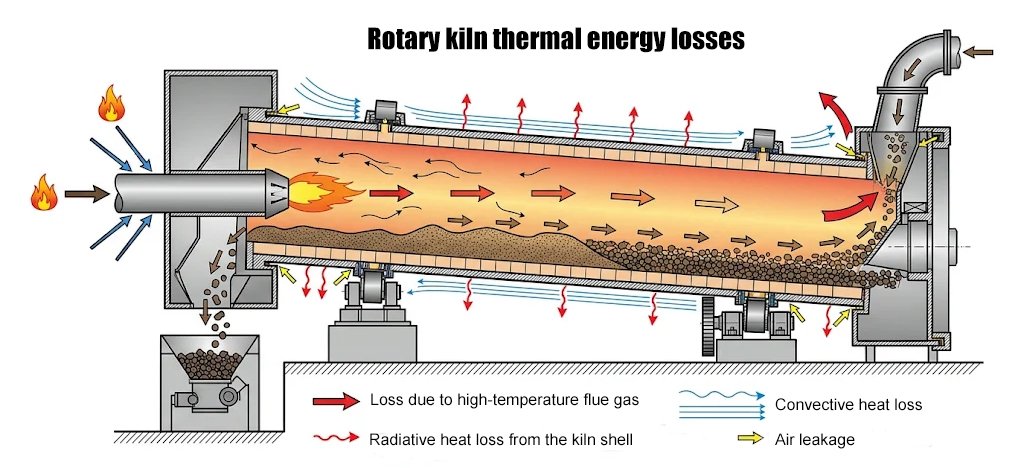
Not all heat generated by fuel can be fully utilized by materials. Part of the heat will be discharged with high-temperature flue gas, and the other part will be lost through the surface of the kiln body.
What are the primary reasons for the low thermal efficiency of a rotary kiln?
Before improving thermal efficiency, one must first identify where heat loss occurs. For most rotary kilns, factors such as the combustion system, refractory materials, flue gas emissions, and the state of the material being processed all influence energy utilization efficiency.
1. Excessive heat loss from the kiln shell surface
During operation, heat is lost from the surface of a rotary kiln through radiation and convection.
If the internal refractory lining becomes worn, cracked, or partially detached, heat is more easily transferred to the steel shell, causing the surface temperature of the kiln to rise.
Common consequences include:
An abnormal increase in the temperature of the kiln’s outer shell.
Increased fuel consumption.
Uneven temperature distribution inside the kiln.
Localized overheating of the shell, which raises the risk of equipment damage.
Infrared thermal imaging equipment can be used to monitor the kiln shell temperature, allowing for the timely detection of abnormally hot areas and helping to determine whether the refractory lining may be damaged.
2. Incomplete Combustion or Excessive Combustion Air
The completeness of fuel combustion directly affects the thermal efficiency of a rotary kiln.
If an excessive amount of combustion air is supplied, that extra air must also be heated—only to be discharged later with the flue gas—resulting in additional heat loss.
Conversely, if the air supply is insufficient, it can lead to incomplete combustion, an unstable flame, and fuel wastage.
During daily operation, key parameters to monitor include:
Oxygen content in the flue gas.
Carbon monoxide (CO) concentration.
Flame shape and stability at the burner.
Fuel flow rate and the volume of combustion air.
Potential air leaks at the kiln inlet and outlet seals.
Therefore, maintaining an optimal fuel-to-air ratio is a crucial measure for enhancing combustion efficiency in a rotary kiln.
3. Excessively High Flue Gas Temperature
High-temperature flue gas carries away a significant amount of heat. If the flue gas temperature remains consistently high, it indicates that a portion of the thermal energy is not being fully utilized.
Common causes include an excess of combustion air, poor heat exchange, unstable feed rates, and the underutilization of waste heat recovery systems.
However, lowering the flue gas temperature should not be done indiscriminately; one must also consider factors such as flue gas composition, the risk of dew-point corrosion, the characteristics of the dust, and the operating conditions of downstream equipment.
4. Improper Material Residence Time
Material residence time refers to the duration that raw materials remain inside a rotary kiln.
If the material moves too quickly, it may be discharged from the kiln before absorbing sufficient heat, resulting in incomplete calcination.
Conversely, if the residence time is too long, it may lead to unnecessary heating, increased fuel consumption, and a reduction in the equipment’s processing capacity.
Factors affecting material residence time primarily include:
Rotational speed of the rotary kiln.
Inclination angle of the kiln shell.
Particle size of the material.
Thickness of the material bed within the kiln.
Flow characteristics of the material.
Proper control of residence time is essential to ensure calcination quality while avoiding energy waste.
5. Excessive Moisture Content in Raw Materials
If the raw materials entering the rotary kiln have a high moisture content, additional heat is required to evaporate the water.
This not only increases the thermal load but can also negatively impact effective production capacity.
For materials with high moisture content, it is advisable to incorporate a dewatering or pre-drying stage upstream. This reduces the moisture entering the rotary kiln, thereby lowering the energy required for subsequent heating.
How can the thermal efficiency of a rotary kiln be improved?
Once the primary causes of heat loss have been identified, optimizations can be implemented across several areas, including combustion control, temperature management, refractory materials, waste heat recovery, and material flow.
1. Optimizing Combustion Conditions and the Fuel-to-Air Ratio
Optimizing the combustion system is one of the most direct ways to enhance the thermal efficiency of a rotary kiln.
The primary objective is to ensure complete fuel combustion while avoiding an excessive supply of combustion air.
Specific measures include:
Adjusting the fuel-to-combustion-air ratio based on actual operating conditions.
Regularly monitoring oxygen and carbon monoxide levels in the flue gas.
Maintaining a stable flame shape and position at the burner.
Inspecting burner nozzles and fuel atomization performance.
Checking the seals at the kiln inlet and outlet to minimize air leakage.
Stabilizing the combustion process leads to more uniform heat distribution and reduces heat loss caused by incomplete combustion or an excess volume of flue gas.
It is important to note that the same air supply parameters cannot be applied to all operating conditions. Combustion parameters must be adjusted whenever there are changes in fuel quality, raw material characteristics, or the kiln load.
Temperature control directly impacts both calcination quality and energy consumption.
Higher temperatures are not necessarily better; rather, an appropriate temperature profile must be established based on the specific process requirements of different zones within the kiln.
For example:
Preheating zone: Gradually increases the temperature of the material and removes a portion of its moisture content.
Heating zone: Supplies the necessary heat to the material.
Calcination zone: Maintains the temperature required for chemical reactions to occur.
Cooling zone: Recovers a portion of the heat from the discharged material, provided the equipment configuration allows for it.
If the temperature is too low, calcination may be incomplete.
Conversely, if the temperature is too high, it not only increases fuel consumption but also accelerates the degradation of refractory materials and may even lead to over-calcination or unwanted chemical reactions.
Therefore, the optimal temperature range for each zone should be determined by considering the properties of the raw materials, product quality requirements, and the desired degree of calcination.
3. Improving Refractory Materials and Thermal Insulation
One of the primary functions of refractory materials is to minimize the transfer of heat from inside the kiln to the external environment. If refractory bricks become worn or cracked, or if the insulation layer is damaged, significant heat loss will occur from the kiln shell.
It is recommended to focus on the following measures:
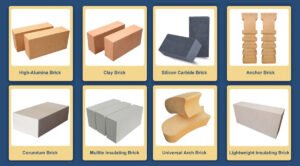
Select appropriate refractory materials based on actual operating temperatures and the chemical environment.
Regularly inspect the thickness and wear status of the refractory bricks.
Promptly repair any damaged refractory lining.
Check the insulation layer for detachment or damage.
Monitor the surface temperature of the kiln shell to identify areas with abnormally high heat.
When selecting refractory materials, consider factors such as thermal conductivity, thermal shock resistance, resistance to chemical erosion, and mechanical stability.
However, a thicker refractory lining is not necessarily better. An excessively thick lining can reduce the effective internal volume of the kiln, increase heat storage, and extend the time required for the equipment to reach operating temperature.
Therefore, the thickness and structure of the refractory lining should be tailored to the specific operating conditions.
4. Waste Heat Recovery from High-Temperature Flue Gas
Waste heat recovery is an essential method for improving the overall energy efficiency of a rotary kiln.
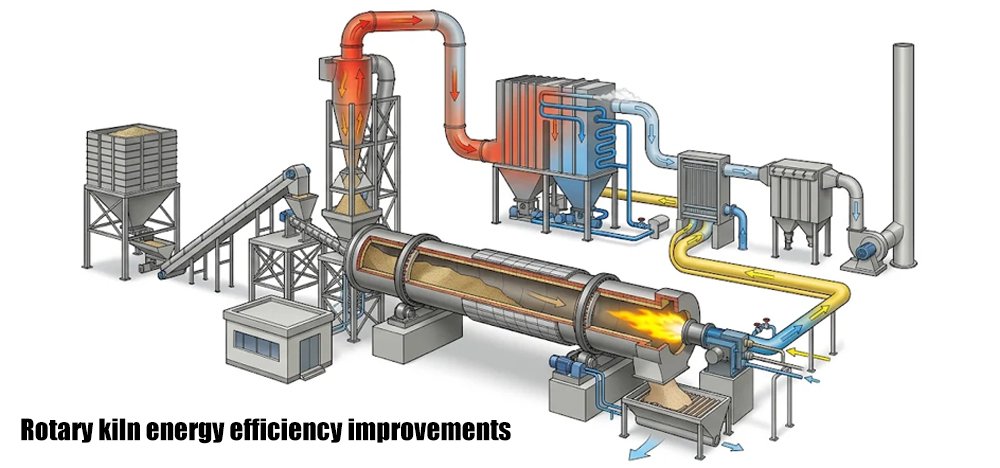
Instead of allowing high-temperature flue gas to be discharged directly, a portion of its heat can be reclaimed using waste heat recovery equipment.
Common applications include:
Preheating raw materials before they enter the rotary kiln.
Pre-drying wet materials.
Preheating combustion air.
Providing heat for auxiliary production equipment.
Generating steam or electricity, provided that technical and economic conditions allow.
For instance, flue gas waste heat can be used to preheat combustion air, thereby reducing the amount of additional heat required during fuel combustion.
It is important to note that waste heat recovery systems must be designed by considering factors such as flue gas temperature, dust content, corrosion risk, system resistance, and actual heat demand—rather than relying solely on theoretical heat recovery potential.
5. Optimizing Material Residence Time and Feed Rate
The behavior of materials as they move through the kiln also affects heat utilization efficiency.
Frequent fluctuations in the feed rate can lead to temperature instability within the kiln, resulting in uneven calcination.
Consequently, it is necessary to coordinate the following parameters:
Rotary kiln rotational speed.
Material feed rate.
Kiln inclination angle.
Raw material particle size.
Thickness of the material bed and the kiln’s fill ratio.
For example, increasing the rotational speed of a rotary kiln may shorten the material’s residence time, thereby reducing the opportunity for the material to come into full contact with the heat.
Conversely, while decreasing the rotational speed may extend the residence time, it could also negatively impact production capacity and material distribution.
Therefore, one cannot rely solely on adjusting the rotational speed to resolve issues; instead, optimization must be achieved through testing that considers both the feed rate and the quality of the final product.
6. Controlling Raw Material Moisture and Particle Size
Raw material pretreatment also influences the energy consumption of a rotary kiln.
Excessive moisture content increases the heat required for drying, while particles that are too large or vary significantly in size can lead to uneven heating, which compromises the calcination process.
In actual production, the following measures can be taken:
Minimize the moisture content of the raw material entering the rotary kiln.
Ensure the particle size of the raw material remains relatively uniform.
Reduce fluctuations in the composition of the raw material.
Optimize upstream screening and crushing processes as needed.
Maintain the stability of the feed system.
The more stable the raw material conditions, the easier it is to manage heat transfer and temperature control within the kiln.
7. Improving Rotary Kiln Sealing to Reduce Air Infiltration
Air leaks are sometimes difficult to detect, as they may not immediately affect the equipment’s output.
However, when cold air enters through the kiln head or kiln tail, it requires additional heating, which ultimately increases both flue gas emissions and energy consumption.
Routine inspections should focus on:
Kiln head sealing mechanisms.
Kiln tail sealing mechanisms.
Connection points at the kiln hood.
Access doors and observation ports.
Flue connections and expansion joints.
Promptly replacing worn-out seals and repairing leaks can prevent unnecessary cold air from entering, helping to maintain the stability of the combustion system.
How can the thermal efficiency of a rotary kiln be monitored and evaluated?
During the operation of a rotary kiln, issues such as high fuel consumption, unstable internal temperatures, or excessively high exhaust gas temperatures may indicate a decline in thermal efficiency. Focusing solely on fuel usage makes it difficult to accurately pinpoint where heat loss is occurring. Evaluating the thermal efficiency of a rotary kiln requires a comprehensive analysis that integrates data on temperatures, fuel consumption, flue gas composition, heat dissipation from the kiln shell, and material heat exchange. Continuous monitoring of these indicators allows for the timely identification of heat losses, enabling the optimization of combustion and operational parameters to reduce energy consumption. The thermal efficiency of a rotary kiln primarily reflects the proportion of heat input from fuel that is effectively utilized for heating, drying, or calcining the material. Routine monitoring should focus on the following key indicators:
Monitoring indicators
Main monitoring content
Assessment purpose
kiln temperature
Temperature of preheating zone, firing zone and cooling zone
Determine whether the temperature distribution is reasonable
Exhaust smoke temperature
Kiln tail flue gas temperature
Determining whether the heat carried away by flue gas is excessive
Fuel consumption
Usage of coal, natural gas, or other fuels
Evaluating energy consumption per unit of output
Flue gas composition
O₂, CO, CO₂, etc.
Assessing the completeness of combustion and the appropriateness of excess air levels
Kiln surface temperature
Surface temperatures at various locations on the kiln shell
Assessing heat loss and the condition of refractory materials
Material temperature
Temperatures of materials at the feed and discharge points
Assessing the effectiveness of heat transfer
These data must be analyzed in conjunction with production load, material moisture content, and raw material properties; thermal efficiency cannot be determined based solely on a single temperature reading.
How to monitor the thermal efficiency of rotary kiln?
1. Monitor the temperature distribution in the kiln
Monitor the temperature changes in different areas of the rotary kiln through thermocouples, infrared thermometers or online temperature measurement systems.
Focus on observing whether the temperatures in the preheating zone, firing zone and cooling zone are stable. If the temperature in the firing zone fluctuates greatly, it may be related to unstable combustion, uneven material distribution or poor heat exchange effect.
2. Monitor fuel consumption
Record the fuel consumption per hour and the corresponding material handling volume, and calculate the fuel consumption per unit product.
For example, if the fuel consumption continues to increase under the same output, it is necessary to check the combustion system, kiln insulation and heat exchange conditions.
3. Monitor exhaust temperature and smoke components
The exhaust temperature is too high, which usually means that more heat is discharged with the flue gas. At the same time, the oxygen and carbon monoxide content in the flue gas can be detected to determine excess air and incomplete combustion.
If the oxygen content of the flue gas is too high, there may be a problem of excessive air taking away heat; if the CO content is abnormally high, you need to check whether the combustion is sufficient.
4. Check the heat dissipation on the surface of the kiln body
Use an infrared thermal imager to detect the surface temperature of the rotary kiln barrel and observe whether there are local high temperature areas.
If the temperature is obviously high in some locations, it may be related to the wear of the refractory bricks, damage to the insulation layer or partial detachment, and further inspection is required.
What pitfalls should be avoided when seeking to improve the thermal efficiency of a rotary kiln?
Certain energy-saving adjustments, if implemented without a sound process-based rationale, may not only fail to reduce energy consumption but could also lead to new equipment issues.
Common mistakes
possible impact
Correct approach
Blindly increase temperature without considering process requirements
Increased fuel and accelerated wear of refractory materials
Properly set the temperature curve
Excessive reduction of combustion air
Insufficient combustion and increased CO
Optimize air supply based on smoke detection
Ignoring refractory damage
Continuous heat dissipation and local overheating of the kiln body
Regularly check kiln temperature and lining
Blindly increase the rotary kiln speed
Insufficient residence time and insufficient calcination
Comprehensive adjustment of speed and feed amount
Install waste heat equipment without considering flue gas conditions
Fouling, corrosion and increased system resistance
First analyze the flue gas properties and heat requirements
Just focus on fuel consumption
Product quality may decline
Simultaneously monitor energy consumption and product quality
The most important point is that energy conservation must not come at the expense of product quality, equipment safety, or production stability.
Rotary Kiln Thermal Efficiency FAQ
Q: What is the thermal efficiency of a rotary kiln?
A: The thermal efficiency of a rotary kiln refers to the proportion of heat generated by fuel combustion that is effectively utilized for heating, drying, or calcining the material. Higher thermal efficiency indicates more effective use of thermal energy and lower fuel consumption.
Q: What factors affect the thermal efficiency of a rotary kiln?
A: Key factors include the calorific value of the fuel, combustion conditions, the airtightness of the kiln shell, thermal insulation performance, the moisture content of the material, temperatures within the kiln, and the utilization of waste heat from exhaust gases.
Q: How can the thermal efficiency of a rotary kiln be improved?
A: Improvements can be achieved by optimizing the combustion system, controlling excess air, enhancing kiln shell insulation, reducing air leakage, stabilizing the feed rate, and recovering waste heat from exhaust gases.
Q: Does heat loss from the rotary kiln shell affect thermal efficiency?
A: Yes. Deterioration of the insulation layer, damage to refractory materials, or insufficient insulation thickness can increase heat loss from the kiln surface, leading to greater energy loss and higher fuel consumption.
Q: Why does air leakage in a rotary kiln reduce thermal efficiency?
A: Air leakage increases the volume of cold air entering the kiln, which causes temperature fluctuations, increases the volume of flue gas, raises heat loss through exhaust, and lowers overall thermal efficiency.
Q: Does an increase in fuel consumption necessarily mean a decline in the rotary kiln’s thermal efficiency?
A: Not necessarily. While increased fuel consumption can indicate a drop in thermal efficiency, it may also be caused by factors such as higher material moisture content, increased production output, changes in the fuel’s calorific value, or suboptimal operating parameters. This should be assessed by analyzing production data.
Q: What are the consequences of excessively high exhaust gas temperatures in a rotary kiln?
A: Excessively high exhaust gas temperatures typically indicate that a significant amount of heat is being lost through the flue gas. This suggests potential for improvement, which can be explored by examining combustion conditions, heat exchange efficiency, and waste heat recovery systems.
Q: Does the rotational speed of a rotary kiln affect its thermal efficiency?
A: Yes. The rotational speed influences the residence time of the material within the kiln and the uniformity of the heating process. Excessive rotational speed may result in insufficient heating of the material, while a speed that is too slow can negatively affect production output and heat distribution; therefore, the speed should be adjusted appropriately based on the specific characteristics of the material.
Q: How can one determine if the thermal efficiency of a rotary kiln has decreased?
A: You can monitor indicators such as fuel consumption per unit of product, exhaust gas temperature at the kiln outlet, surface temperature of the kiln shell, product quality, and temperature fluctuations within the kiln. If fuel consumption continues to rise or temperature control becomes unstable, the thermal system should be inspected.
Q: Can waste heat recovery in a rotary kiln improve thermal efficiency?
A: Yes, it can. By using waste heat boilers, preheaters, or other heat recovery equipment to capture heat from high-temperature flue gases—and subsequently using that heat to preheat air or raw materials, or to generate steam—it is possible to reduce heat waste and lower the energy consumption per unit of product.
Summary
To save fuel in a rotary kiln, the key is first to identify where heat is being wasted. Factors such as an excess of combustion air, excessively high exhaust gas temperatures, damaged refractory lining, or an improper material residence time can all lead to unnecessary fuel consumption.
In actual production, energy consumption can be reduced by optimizing combustion parameters, controlling kiln temperatures, improving thermal insulation, recovering waste heat, and stabilizing the material feed.
However, energy conservation should not be measured solely by the amount of fuel saved; it must also account for maintaining calcination quality, production output, and stable equipment operation. Ultimately, an effective rotary kiln is one that not only saves fuel but also ensures consistent production and reliable product quality.
If your rotary kiln is experiencing issues such as high fuel consumption, uneven temperatures, or frequent damage to the refractory lining, please feel free to contact us. By providing details about your equipment model and current production conditions, we can help you analyze the root causes and develop a tailored energy-saving optimization plan.
Sand is a fine-grained material of small minerals or rock fragments, mainly formed by rock weathering or mineral fragmentation, with grain sizes usually ranging from 0.0625 mm to 2 mm (according to the international standard ISO 14688). Sand can...
Many cement plants undoubtedly face a common challenge: frequent downtime caused by damaged refractory materials. You are surely well aware that the rotary kiln lies at the very heart of the entire production process. It is within this vessel tha...
If you inquire about the price of a rotary kiln, you may receive varying quotes—sometimes with significant differences. It is crucial to understand exactly what is included in these quotes; equipment that appears similar in size can ultimately di...
A rotary kiln may look like nothing more than a large, continuously rotating cylinder, but keeping it running stably is far from simple. Even a slight misalignment can lead to uneven contact between the riding ring (tire) and the support rollers,...
 Chunlei Rotary kiln