The choice between a direct-heated rotary kiln and an indirect-heated rotary kiln directly impacts product quality, fuel consumption, process control, and equipment service life. Making the right selection requires more than just considering the heating method; it necessitates a comprehensive evaluation of material characteristics, required calcination temperatures, residence time, furnace atmosphere, and the specific requirements for refractory materials.
This article provides a detailed overview of the key differences between direct-heated and indirect-heated rotary kilns, compares their operational characteristics, and offers practical selection guidelines to help you make a well-informed decision.
What is the difference between direct-heated and indirect-heated rotary kilns?
The primary difference between direct-heated and indirect-heated rotary kilns lies in how they heat the material.
In a direct-heated rotary kiln, high-temperature combustion gases come into direct contact with the material. In an indirect-heated rotary kiln, the kiln is heated from the outside, keeping the material separate from the combustion gases; heat is transferred to the material through the kiln shell. This distinction affects factors such as heat transfer efficiency and product purity.
Direct-Fired Rotary Kiln
Suitable for thermal processing applications where the material can tolerate direct contact with combustion gases and where high throughput is required.
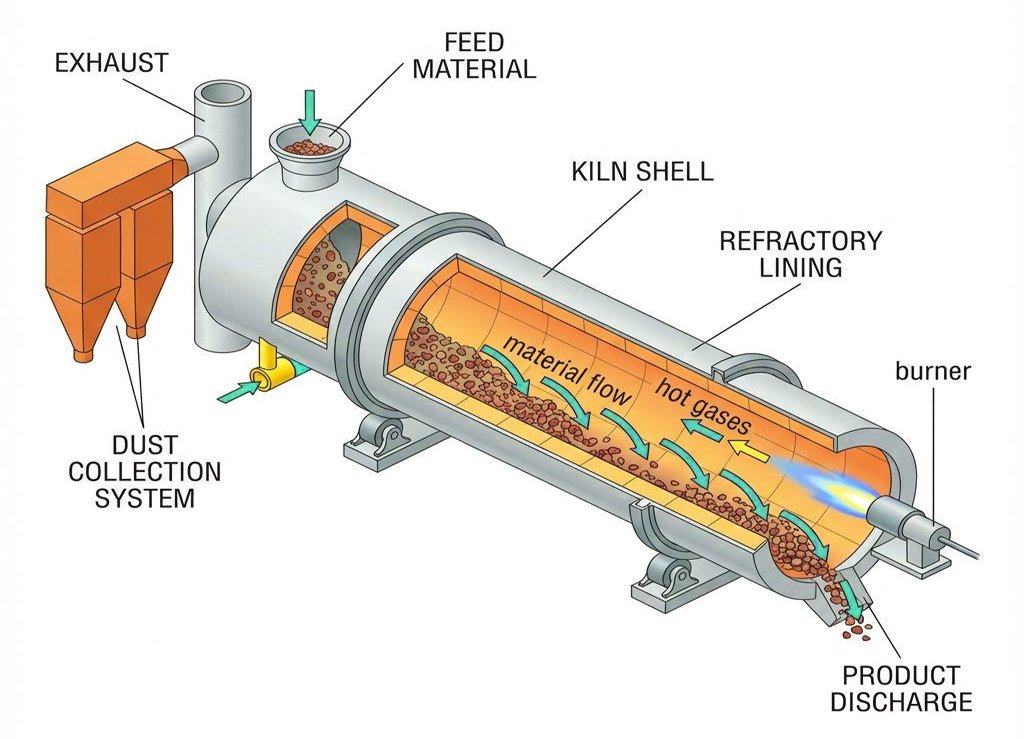
High-temperature gases come into direct contact with the material.
Generally offers higher heat transfer efficiency.
Typically lined with refractory materials.
Indirect-Fired Rotary Kiln
Suitable for materials that must be kept separate from combustion gases, require a controlled internal atmosphere, or where the risk of product contamination must be minimized.
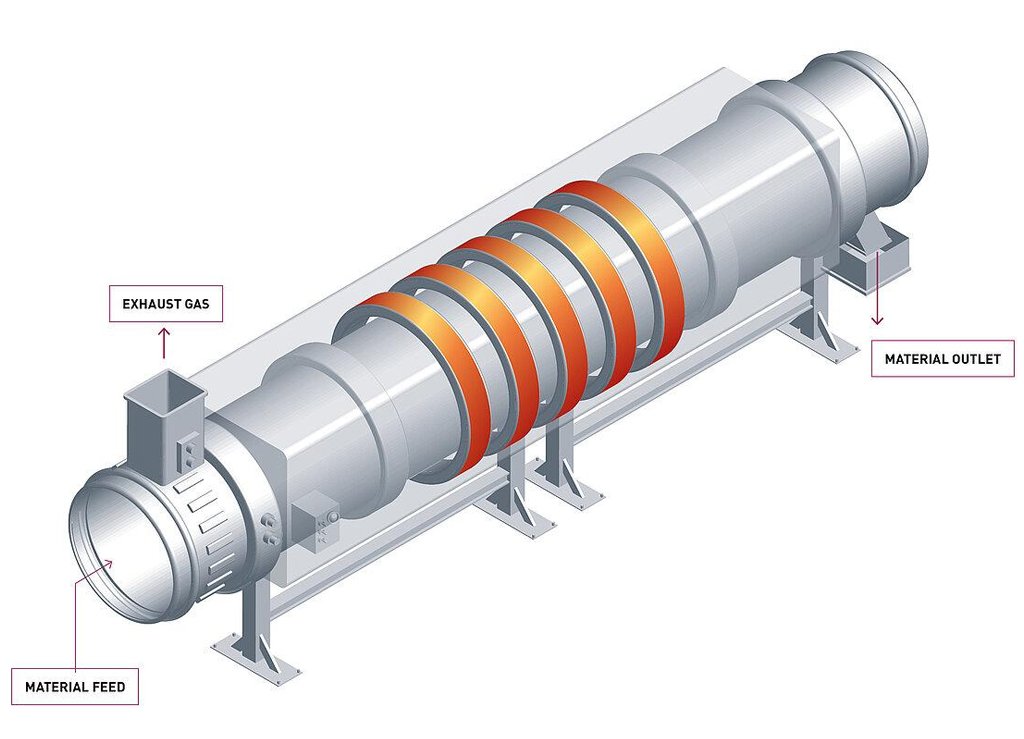
Heat is transferred through the kiln shell.
Facilitates the isolation and control of the process atmosphere.
May require a kiln shell made of high-temperature resistant alloys.
It is important to note that neither type of rotary kiln is inherently superior; the correct choice depends on the properties of the material, the chemical reactions involved, production targets, and acceptable operating costs.
Working Principle of Directly Heated Rotary Kilns
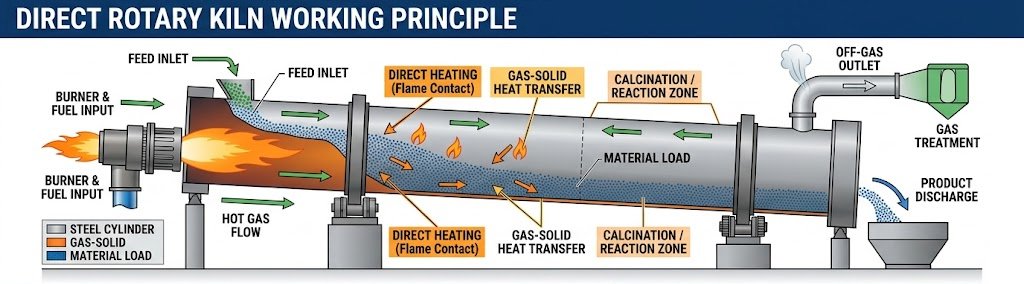
In a directly heated rotary kiln, fuel is typically combusted inside the kiln, or high-temperature combustion gases are introduced directly into the material processing zone. As the kiln shell rotates, the material is continuously tumbled and brought into contact with the high-temperature gases, absorbing heat through convection, radiation, and direct contact with heated surfaces.
DIRECT ROTARY KILN WORKING PRINCIPLE
Key Advantages:
High heat transfer efficiency: Direct contact between high-temperature gases and the material minimizes thermal resistance that would otherwise occur if heat had to pass through the kiln shell.
High throughput: Widely used for large-scale mineral processing and industrial calcination.
Robust and mature design: Refractory linings protect the kiln shell from high temperatures and material abrasion.
Flexible gas flow configuration: Can be set up for either co-current or counter-current flow, depending on process requirements.
Key Limitations:
Combustion gases may affect the chemical composition, oxidation state, or purity of the final product.
Fine particles may be entrained in the gas stream, necessitating the use of dust collection equipment.
Gas velocity, oxygen content, and flame positioning must be carefully controlled to prevent localized overheating.
Maintenance costs may be increased by factors such as refractory wear, thermal cycling, and the formation of rings or material buildup (accretion).
Directly heated rotary kilns are commonly used for lime production, mineral calcination, and other large-scale thermal processing operations. However, their suitability for a specific application must be evaluated based on the chemical properties of the material and the requirements for the final product.
Working Principle of Indirectly Heated Rotary Kilns
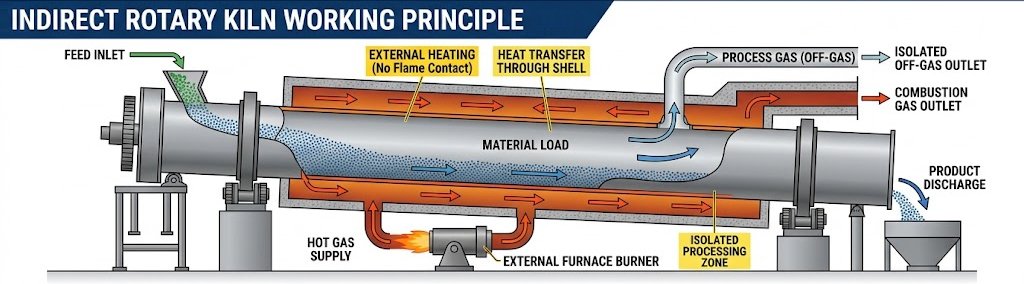
In an indirectly heated rotary kiln, burners or electric heating elements are positioned outside the rotating processing cylinder. Heat is first transferred to the kiln shell and then passes through the shell into the material.
Because combustion gases do not come into direct contact with the product, this design helps reduce the risk of contamination by combustion byproducts and offers greater flexibility in controlling the process atmosphere.
However, the kiln shell itself becomes a critical component of the overall heat transfer system; its material, thickness, temperature, and surface area all influence the equipment’s performance.
INDIRECT ROTARY KILN WORKING PRINCIPLE
Key Advantages:
Enhanced Atmosphere Control: When combined with appropriate sealing and gas management systems, it can be used for thermal processing in inert, reducing, or other controlled atmospheres.
Reduced Risk of Product Contamination: Helps prevent the product from coming into direct contact with combustion gases.
Suitable for Certain Fine-Powdered Materials: Indirect heating can be advantageous when it is necessary to minimize particle entrainment caused by high-velocity combustion gases.
Supports Zonal Heating: Multiple heating zones can be established to meet specific temperature requirements for different stages of the process.
Key Limitations:
Heat must pass through the kiln shell, which may limit the rate of heat transfer.
The inclusion of external heating chambers, insulation systems, sealing mechanisms, and a high-temperature-resistant kiln shell can increase capital investment.
Requires close monitoring of the kiln shell temperature and thermal stress.
Production capacity may be constrained by the effective heat transfer surface area and the characteristics of the material.
Indirectly heated rotary kilns are frequently used for specialized calcination, the thermal processing of fine powders, and applications that demand high product purity or precise control over the furnace atmosphere.
Important Note: Indirect heating does not necessarily guarantee more uniform temperatures or lower energy consumption. Actual performance depends on the equipment design, heat flux density, material properties, operating conditions, insulation efficiency, and overall thermal engineering.
Key Differences Between Direct-Heating and Indirect-Heating Rotary Kilns
The primary distinction between direct-heating and indirect-heating rotary kilns lies in the method of heat transfer and whether the material comes into direct contact with combustion gases. In direct-heating kilns, heat is transferred through direct contact between high-temperature gases and the material—a configuration typically suited for high-throughput processes that prioritize efficient heat transfer. In contrast, indirect-heating kilns transfer heat through the kiln shell, making them better suited for applications with specific requirements regarding product purity, contamination control, or the kiln atmosphere. When selecting equipment, one should look beyond mere capital cost or maximum operating temperature; it is essential to conduct a comprehensive evaluation that accounts for material characteristics, fuel consumption, the required degree of calcination, residence time, refractory materials, and total operating costs.
Comparison Criteria
Direct-Fired Rotary Kiln
Indirect-Fired Rotary Kiln
Heat Transfer Method
High-temperature combustion gases come into direct contact with the material
Heat is transferred to the material through the kiln shell
Heat Transfer Efficiency
Generally higher; suitable for large-scale continuous production
Limited by the heat transfer capacity of the kiln shell and heat losses
Temperature Control
Regulated via burners, gas flow, and feed rate
Temperature can be controlled through zoned external heating
Fuel Consumption
Energy consumption per unit of product may be lower under optimal operating conditions
May require additional energy to compensate for heat losses inherent in indirect heat transfer
Product Purity
Combustion gases may affect product composition or purity.
Direct contact between the product and combustion gases can be minimized.
Furnace Atmosphere
Highly influenced by the composition of combustion gases
Allows for easier isolation and control of the process atmosphere
Material Suitability
Suitable for materials that can tolerate direct contact with hot gases
Suitable for materials sensitive to contamination, oxidation, or specific atmospheric conditions
Fine Powder Handling
Requires attention to dust entrainment caused by gas flow
Offers potential advantages in reducing direct entrainment by combustion gas flows
Refractory Materials and Kiln Shell
Typically lined with refractory materials to protect the kiln shell
Often utilizes high-temperature alloy kiln shells, depending on the specific design
Equipment Structure
Conventional designs are relatively simple
External heating chambers, sealing systems, and specialized kiln shells may increase complexity
Capital Investment
Generally lower for conventional, large-scale applications
Specialized materials and heating systems may increase investment costs
Key Maintenance Areas
Wear of refractory materials, ring formation, burner systems, and off-gas systems
Thermal stress on the kiln shell, sealing, heating systems, and shell wear
Typical Applications
Lime calcination, mineral calcination, and large-scale thermal processing
Specialized calcination, atmosphere-controlled thermal processing, and the processing of certain fine powders
How to choose?
Opt for direct heating when: The material can tolerate contact with combustion gases, the production scale is large, and high heat-transfer efficiency and throughput are priorities.
Opt for indirect heating when: The product requires high purity, the reaction atmosphere (e.g., to prevent oxidation) must be strictly controlled, or it is necessary to minimize the interaction between combustion gases and the material.
Summary: Direct-heated rotary kilns generally excel in heat-transfer efficiency and large-scale production capacity, while indirect-heated rotary kilns offer advantages in material isolation and atmospheric control. The final selection should be determined through process testing, taking into account factors such as raw material properties, target calcination temperature, residence time, product quality, and total life-cycle costs.
How to Select the Right Rotary Kiln?
The selection of a rotary kiln should be based on the properties of the raw materials and the requirements for the final product, rather than starting with a decision on a specific type of equipment.
Step 1: Understand Raw Material Characteristics
Before selecting a rotary kiln, it is essential to determine the following:
Chemical and mineralogical composition
Moisture content and drying requirements
Particle size distribution and bulk density
Thermal conductivity and specific heat capacity
Characteristics of decomposition or other thermal reactions
Sensitivity to oxygen, moisture, and combustion by-products
Tendency toward sticking, agglomeration, dust generation, or ring formation
These characteristics influence the rate at which the material heats up, its movement within the kiln, and its suitability for direct contact with combustion gases.
Step 2: Determine the Required Calcination Temperature
The target temperature should be dictated by the desired degree of chemical transformation or the required properties of the final material.
For example, the calcination of limestone is the process of decomposing calcium carbonate into calcium oxide and carbon dioxide. The actual temperature and operating conditions required depend on raw material characteristics, particle size, gas composition, and reaction kinetics—rather than simply setting a fixed, arbitrary temperature.
Excessively high temperatures may lead to sintering or a loss of product reactivity, while insufficient temperatures may result in incomplete decomposition.
Step 3: Define the Required Kiln Atmosphere
It is necessary to determine whether the process requires:
An oxidizing atmosphere
A reducing atmosphere
An inert atmosphere
Limited exposure to oxygen
The separate recovery of volatile by-products
If the material must be kept isolated from combustion gases, indirect heating solutions should be considered. Furthermore, atmosphere control depends on factors such as sealing, the flow rate of protective gases, potential air leakage, and the design of the exhaust system.
Step 4: Determine Throughput and Residence Time
Residence time refers to the duration the material spends inside the rotary kiln; it directly influences drying, heating, decomposition, and other reaction processes.
Even if a rotary kiln reaches the target temperature, incomplete calcination can still occur if the material’s actual reaction time is insufficient. Conversely, an excessively long residence time may reduce processing capacity or trigger undesirable side reactions.
Therefore, design considerations should not focus solely on the average residence time, but also on the actual distribution of residence times.
Step 5: Compare Overall Operating Costs
Evaluate the costs associated with the complete thermal processing system, including:
Fuel or electricity consumption
Efficiency of burners and combustion systems
Costs for exhaust gas treatment and dust removal
Maintenance expenses for refractory materials or the kiln shell
Product loss and the rate of non-conforming (rejected) products
Labor, downtime, and maintenance costs
Downstream cooling and gas handling costs
A lower initial equipment price does not necessarily equate to the lowest overall production cost. If the equipment leads to inconsistent product quality or increases the costs of exhaust gas treatment, its long-term economic performance may actually be worse.
Step 6: Validate Equipment Selection Through Testing
For projects involving materials with poorly defined properties or narrow reaction temperature windows, laboratory-scale or pilot-scale testing should be conducted.
Focus on analyzing the chemical composition of the product, the degree of reaction conversion, specific energy consumption, dust loss, and material flow/movement characteristics before finalizing the design. When scaling up to an industrial level, it is also necessary to account for heat transfer limitations and changes in residence time distribution.
Common Mistakes in Rotary Kiln Selection
Mistake 1: Focusing solely on the maximum operating temperature.
A rotary kiln must meet the specific temperature requirements of the material and the necessary reaction conditions—simply reaching a certain gas or kiln shell temperature is not sufficient.
Mistake 2: Assuming that direct heating is always more energy-efficient.
While direct heating often offers superior heat transfer efficiency, actual energy consumption also depends on factors such as material moisture content, feed rate, exhaust losses, thermal insulation, and specific product requirements.
Mistake 3: Believing that indirect heating guarantees complete control over the atmosphere.
The internal atmosphere can still be compromised by issues such as poor sealing, insufficient protective gas flow, gas leaks, or inadequate exhaust system design.
Mistake 4: Attempting to compensate for insufficient residence time by increasing fuel input.
Higher temperatures cannot always offset inadequate reaction time or poor material movement. Both temperature and residence time must be evaluated together.
Mistake 5: Neglecting the maintenance of refractory materials and the kiln shell.
Damage to refractory materials can expose the kiln shell to excessively high temperatures. In indirect heating systems, degradation of the kiln shell can also impair heat transfer efficiency and mechanical reliability.
Mistake 6: Comparing only the initial purchase price without considering the total life-cycle cost.
The selection process should account for installation costs, fuel or electricity consumption, maintenance expenses, exhaust gas treatment, product quality, and losses incurred during downtime.
FAQ
Q: What are the main differences between direct-heated and indirect-heated rotary kilns? A: In a direct-heated rotary kiln, heat is transferred through direct contact between high-temperature combustion gases and the material. In an indirect-heated rotary kiln, heat is transferred through the kiln shell, keeping the material isolated from the combustion gases.
Q: Which type of rotary kiln is more energy-efficient? A: Direct-heated rotary kilns generally offer better heat transfer efficiency because the high-temperature gases come into direct contact with the material. However, the actual energy consumption for both types depends on factors such as the properties of the raw materials, process conditions, exhaust heat losses, and the overall design of the thermal system.
Q: Can an indirect-heated rotary kiln operate in an inert atmosphere? A: Yes. With the appropriate configuration—including seals, a protective gas system, atmosphere monitoring, and exhaust equipment—an indirect-heated rotary kiln can be used for processing in an inert atmosphere. Note, however, that the use of an indirect-heating design alone does not guarantee a completely oxygen-free environment inside the kiln.
Q: How are the appropriate calcination temperature and residence time determined? A: First, it is necessary to define the reaction mechanism of the material and the specifications for the target product. Then, the optimal temperature range and reaction duration are determined through laboratory or pilot-scale testing. When scaling up to industrial equipment, the actual heat transfer capacity and residence time distribution must also be verified.
Q: Do direct-heated rotary kilns always require a refractory lining? A: While designs vary, direct-heated rotary kilns typically feature a refractory lining to protect the kiln shell from high temperatures, mechanical wear, and chemical erosion. Indirect-heated rotary kilns, by contrast, often utilize a high-temperature-resistant shell and may not include an internal refractory lining, as the shell itself must facilitate the transfer of heat to the material.
Summary
When it comes to tin ore processing, you shouldn’t simply copy the equipment used by others; the key is to understand the specific characteristics of your own ore. By thoroughly analyzing your ore first, you can then determine the right process and select the appropriate equipment—helping you avoid unnecessary pitfalls. Choosing the wrong processing route will not only hinder your tin recovery rate but also lead to avoidable increases in both capital investment and production costs.
Which processing method is best suited for your tin ore? Feel free to contact us and provide details regarding your ore samples and required processing capacity. We will help you analyze the characteristics of your ore and explore the most suitable processing flow and equipment configuration.
In the competitive mining and cement industries, energy efficiency and production cost control are the core of enterprise profitability. High energy consumption, low thermal efficiency and unstable calcination quality of traditional rotary kilns ...
When selecting a rotary kiln, many customers view it simply as a large heating cylinder without fully understanding its operating mechanism. In reality, the basic principle is straightforward.Raw materials enter the kiln at the higher end, while ...
Many people know that cement is derived from limestone, but few are familiar with the transformation process involved. The journey from limestone in the quarry to the final bag of cement entails a complex series of mineral processing and therma...
Adjusting the flue gas control ratio of lime kiln rotary kiln (usually refers to the ratio of key components in the flue gas, such as O₂, CO, NOx, SO₂, etc.) needs to take into account the combustion efficiency, environmental protection requireme...
 Chunlei Rotary kiln