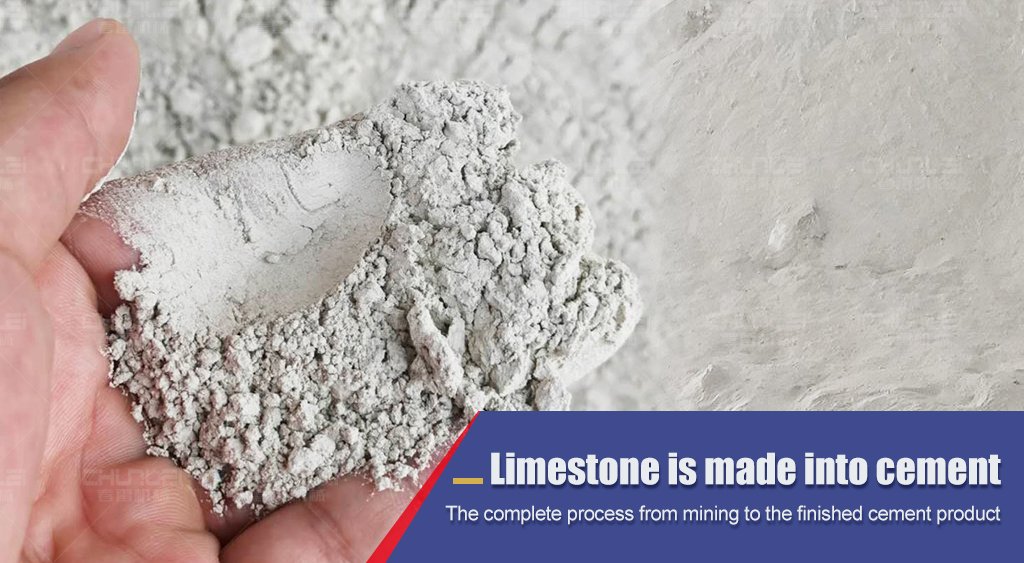
Many people know that cement is derived from limestone, but few are familiar with the transformation process involved.
The journey from limestone in the quarry to the final bag of cement entails a complex series of mineral processing and thermal treatment stages, including:
Cement quality is determined not by any single piece of equipment, but by the overall coordination of the production process. Factors such as the stability of limestone composition, the accuracy of raw material proportions, the appropriateness of rotary kiln temperatures, and the adequacy of clinker cooling all impact the final cement strength and production costs. Modern dry-process cement production typically involves clinker burning using a preheater, a pre-calciner system, and a rotary kiln, followed by grinding the clinker with materials like gypsum to produce the final cement.
For a cement plant, the goal is not merely to “burn the limestone”; rather, it is to ensure high clinker quality while improving thermal efficiency, reducing energy consumption, and maintaining stable, long-term production.
Why can limestone be used to make cement?
The primary component of limestone is calcium carbonate (CaCO₃), making it the most important calcium-bearing raw material in cement production.
However, limestone alone cannot develop the strength required for cement.
During cement production, the following materials are typically added:
Clay (supplying silicon and aluminum)
Iron ore (adjusting iron content)
Sandstone or other corrective materials
When these raw materials react at high temperatures, they form a product known as cement clinker. This clinker is then ground with a small amount of gypsum to produce the cement we commonly use.
The Complete Process of Cement Production from Limestone
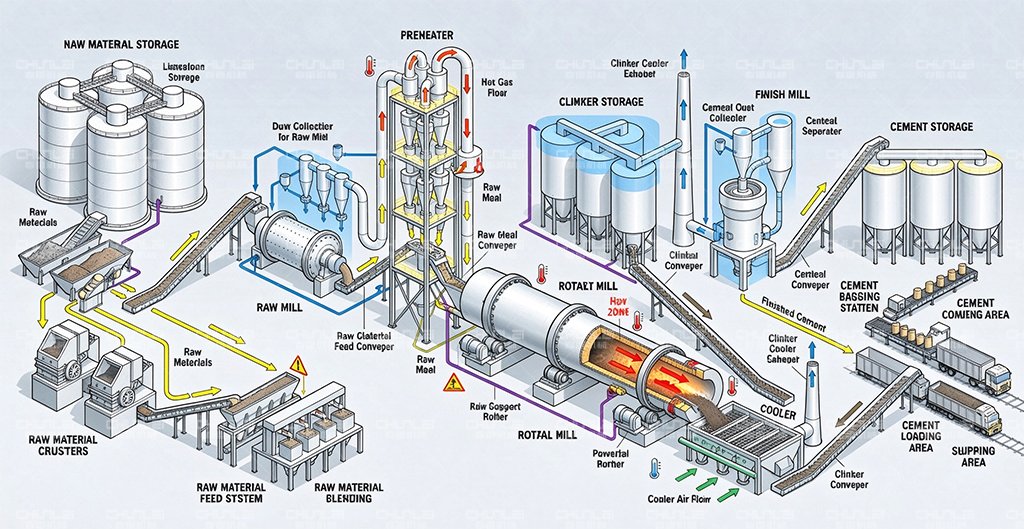
The complete process of producing cement from limestone primarily involves:
Limestone extraction → crushing → proportioning → raw meal grinding → preheating and decomposition → clinker firing → clinker cooling → cement grinding → packaging and dispatch. The primary component of limestone, calcium carbonate (CaCO₃), decomposes at high temperatures to produce calcium oxide (CaO); this subsequently reacts with silica, alumina, and iron oxide found in raw materials such as clay and iron ore to form cement clinker. After adding an appropriate amount of gypsum and grinding, the clinker is transformed into the finished cement used in construction projects. The process flow for cement production from limestone is outlined below:
Process Step
Key Activities
Major Equipment
Function and Description
1. Limestone Mining
Extracting limestone ore from the quarry
Drilling rigs, excavators, transport vehicles
Obtaining the primary calcareous raw material for cement production
2. Limestone Crushing
Breaking large limestone blocks into smaller particles
Jaw crushers, impact crushers
Reducing particle size to facilitate storage and grinding
3. Raw Material Pre-homogenization
Mixing and homogenizing raw materials (e.g., limestone)
Stackers, reclaimers
Stabilizing raw material composition; improving cement quality
4. Raw Material Proportioning
Mixing limestone, clay, and iron ore in specific ratios
Automatic proportioning system
Adjusting the content of CaO, SiO₂, Al₂O₃, and Fe₂O₃
5. Raw Meal Grinding
Grinding mixed raw materials into fine powder
Vertical mills, ball mills
Producing uniform fine powder; preparing for clinker calcination
What are the main pieces of equipment required for cement production using limestone?
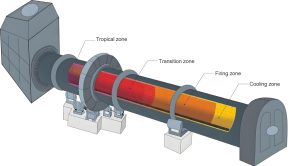
The core equipment for limestone-based cement production includes: crushers, raw material mills, preheaters, rotary kilns, grate coolers, cement mills, and packaging equipment. Among these, the rotary kiln system is the critical component of the entire production line.
1. Limestone Crushing
Large limestone blocks are crushed into small particles meeting specific requirements to facilitate subsequent proportioning and grinding, thereby improving production efficiency.
Main Equipment:
Jaw crusher
Impact crusher
Conveyor
2. Raw Meal Preparation
Limestone is mixed with raw materials such as clay in specific proportions and ground to produce a homogeneous cement raw meal.
Main Equipment:
Raw material mill (vertical mill/ball mill)
Powder separator
Dust collection equipment
3. Clinker Calcination
The raw meal enters a high-temperature rotary kiln and is calcined at approximately 1450°C to form cement clinker; this is the core stage of cement production.
High-temperature clinker is rapidly cooled while heat is recovered to improve energy efficiency.
Main Equipment:
Grate cooler
Cooling fan
5. Cement Grinding
Clinker is ground together with gypsum and blending materials to produce cement products that meet industry standards.
Main Equipment:
Cement mill
Roller press
Powder separator
6. Cement Storage and Packaging
Finished cement is stored in silos and shipped either in bags or in bulk according to demand, completing the final sales stage.
Main Equipment:
Cement silo
Packaging machine
Bulk loading system
How do limestone properties affect cement quality?
Not all limestone is suitable for producing high-quality cement. High-quality limestone provides a stable source of calcium oxide (CaO), facilitating the proper formation of clinker minerals; conversely, compositional fluctuations or excessive impurity levels can compromise cement performance. Therefore, effectively controlling limestone quality is crucial for ensuring the quality of the final cement product.
Impact of limestone properties on cement quality:
Calcium oxide (CaO) content
CaO is a key component in cement clinker formation; appropriate levels help enhance clinker strength.
Insufficient content leads to incomplete clinker mineral formation, hindering strength development.
Calcium carbonate purity
High-purity limestone minimizes the adverse effects of impurities and improves the consistency of cement performance.
Excessive impurities can disrupt the firing process and reduce cement quality.
Magnesium oxide (MgO) content
Moderate amounts of MgO can help improve clinker properties.
Excessive levels can cause long-term volume expansion in the cement, compromising structural stability.
Impurity content (silicon, aluminum, iron, etc.)
These elements participate in clinker mineral formation and influence setting time and strength.
Imbalanced levels can lead to fluctuations in clinker quality.
Limestone particle size and grindability
Limestone with uniform particle size and good grindability facilitates thorough raw material mixing and improves firing efficiency.
Excessive or uneven particle size can affect reaction rates and clinker uniformity.
Mineral structure and crystallinity
Limestone with a loose structure decomposes more easily, helping to reduce energy consumption.
Excessively dense crystalline structures can make calcination more difficult and reduce production efficiency.
Moisture content
High moisture content increases energy consumption during grinding and transport, affecting production stability.
Proper moisture control helps improve production efficiency.
Limestone quality establishes the “raw material foundation” for cement production. By controlling CaO content, impurity levels, particle size, and mineral characteristics, manufacturers can optimize clinker formation and enhance cement strength, durability, and product consistency.
Common Misconceptions in Cement Production
Believing that higher limestone purity is always better
While high limestone purity certainly helps improve quality, higher purity is not necessarily optimal for production. Cement manufacturing requires a balanced chemical composition; appropriate levels of silicon, aluminum, and iron are essential for forming stable clinker minerals.
Focusing solely on raw material composition while neglecting homogenization
Consistent chemical composition is more important than data from a single test. Significant compositional fluctuations can destabilize kiln conditions and compromise clinker quality.
Believing that higher firing temperatures always yield higher cement strength
Excessive firing temperatures do not lead to limitless strength gains; instead, they can cause clinker agglomeration, increase energy consumption, and even impair clinker reactivity.
Neglecting clinker quality and relying only on adjustments during the grinding stage
Cement performance is fundamentally rooted in the clinker. If the clinker’s mineral composition is flawed, simply increasing grinding fineness or adjusting mix proportions cannot fully compensate for the deficiency.
Believing that finer cement always results in higher strength
Grinding fineness affects early strength, but excessive grinding increases energy consumption and can lead to higher water demand and increased shrinkage in the cement.
Focusing only on 3-day and 7-day strength while ignoring long-term performance
Cement quality is defined not only by early strength but also by comprehensive indicators such as later-age strength, durability, and volume stability.
Overlooking the impact of supplementary cementitious material quality on cement performance
While materials like fly ash, slag, and limestone powder can reduce costs, their reactivity, dosage, and compatibility significantly influence the final cement’s performance.
Believing that advanced equipment guarantees cement quality
Although automated equipment and advanced processes enhance control capabilities, factors such as raw material management, process parameter optimization, and the experience of production personnel are equally critical in determining product quality.
FAQ
Q: Why is limestone a primary raw material for cement production? A: Limestone is rich in calcium carbonate (CaCO₃). Upon calcination, it yields calcium oxide (CaO), which reacts with other raw materials to form the key minerals in cement clinker, making it an indispensable base material for cement production.
Q: Does the quality of limestone affect the quality of the cement? A: Yes. Factors such as the CaO content, impurity levels, and mineral structure of the limestone influence the clinker formation process, thereby affecting the cement’s strength, setting time, and durability.
Q: Does higher-purity limestone result in better cement? A: Not necessarily. While high-purity limestone facilitates stable production, cement manufacturing requires a balanced chemical composition; appropriate amounts of silicon, aluminum, and iron are also beneficial for forming high-quality clinker minerals.
Q: What are the main steps in producing cement from limestone? A: The process typically includes limestone quarrying, crushing, pre-homogenization, proportioning, grinding, raw meal calcination, clinker cooling, clinker grinding, and the addition of blending materials.
Q: Why must limestone be ground before entering the cement production process? A: Grinding reduces the particle size of the limestone, allowing it to mix thoroughly with other raw materials; this improves reaction efficiency during calcination and ensures uniform clinker quality.
Q: What are the consequences of excessive magnesium oxide (MgO) content in limestone? A: Excessive MgO content can cause delayed volume expansion in the cement, compromising the stability of the concrete structure; therefore, its content must be strictly controlled during production.
Q: Does a high clay content in limestone affect cement production? A: Yes. Excessive clay and impurities alter the chemical composition of the raw materials, affecting the accuracy of proportioning and the effectiveness of clinker calcination, which reduces the consistency of cement quality.
Q: Why does cement produced from limestone from different regions exhibit varying performance characteristics? A: Limestone from different quarries varies in chemical composition, impurity levels, and mineral structure; producing cement with consistent performance requires appropriate proportioning and process adjustments.
Q: What changes occur during the calcination of limestone? A: Limestone decomposes at high temperatures, releasing carbon dioxide (CO₂) and producing calcium oxide (CaO), which subsequently reacts with oxides such as silicon, aluminum, and iron to form cement clinker minerals.
Q: How can the quality of cement produced from limestone be improved? A: It is necessary to strengthen limestone quality control, optimize raw material proportions, enhance homogenization, stabilize kiln firing conditions, and ensure thorough testing of both the clinker and the finished cement.
Summary
From limestone quarrying and crushing to high-temperature calcination and clinker grinding, every step of the process determines the quality and performance of the cement. Understanding how limestone is transformed into cement not only provides insight into the building material production process but also helps enterprises select the most suitable raw materials and production strategies.
Interested in learning more about cement production processes, equipment configurations, or customized solutions? Contact us today for professional consultation and support.
Chunlei Machinery, a professional rotary dryer manufacturer with over two decades of experience, is excited to announce the successful export of a 1800×12m Rotary Drum Dryer to the Philippines. This latest delivery underscores our position as a t...
If you work in the mining, calcination, or mineral processing industry, you've likely encountered these problems: they are not only dirty and messy, but also consume enormous amounts of fuel, often failing to meet environmental standards. Chunl...
Whether you operate a mineral processing plant, an alumina refinery, or a mining operation, you understand that the calcination process is crucial to product quality. An unsuitable rotary kiln is not only wasteful of materials, time, and money, b...
Adjusting the flue gas control ratio of lime kiln rotary kiln (usually refers to the ratio of key components in the flue gas, such as O₂, CO, NOx, SO₂, etc.) needs to take into account the combustion efficiency, environmental protection requireme...
 Chunlei Rotary kiln