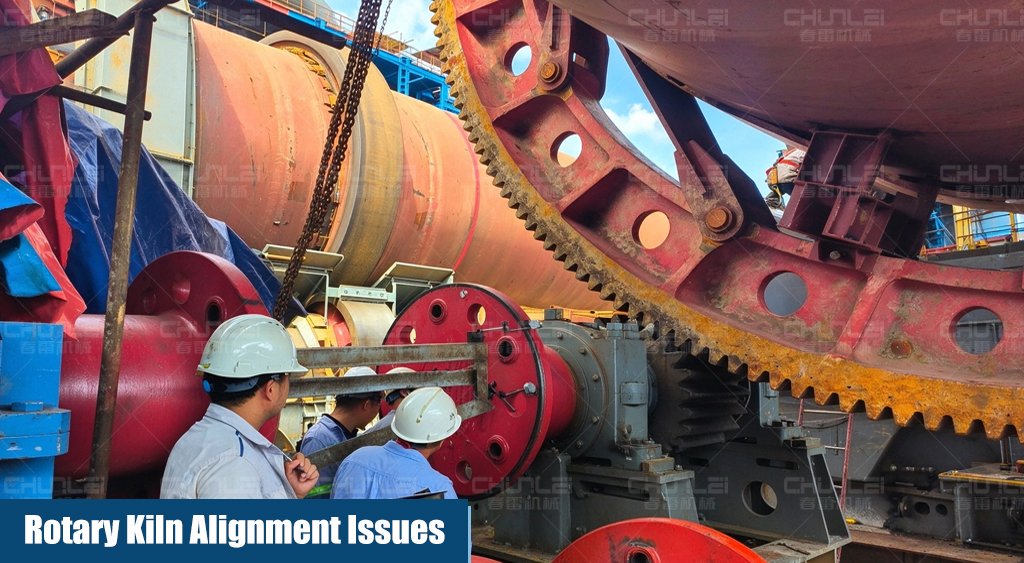
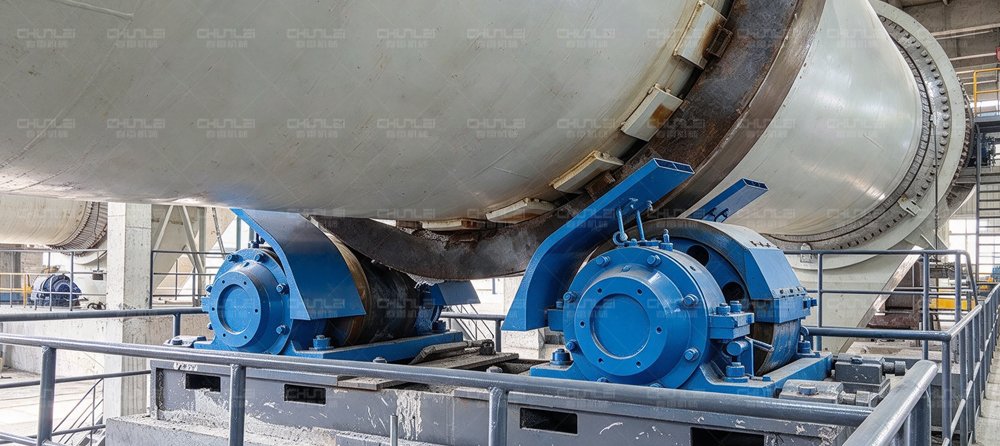
A rotary kiln may look like nothing more than a large, continuously rotating cylinder, but keeping it running stably is far from simple. Even a slight misalignment can lead to uneven contact between the riding ring (tire) and the support rollers, resulting in wear, vibration, and abnormal noise—not to mention an increased load on the drive motor.
If left unaddressed, these issues can eventually cause the kiln shell to deform or the refractory lining to sustain damage; in severe cases, it may even necessitate a complete shutdown for repairs.
So, how can these problems be detected in a timely manner? In the following sections, we will examine five common types of rotary kiln misalignment—exploring why they occur, how they manifest, and how to address them—to help you minimize equipment wear and avoid unnecessary maintenance costs.
Why Is Rotary Kiln Alignment Important?
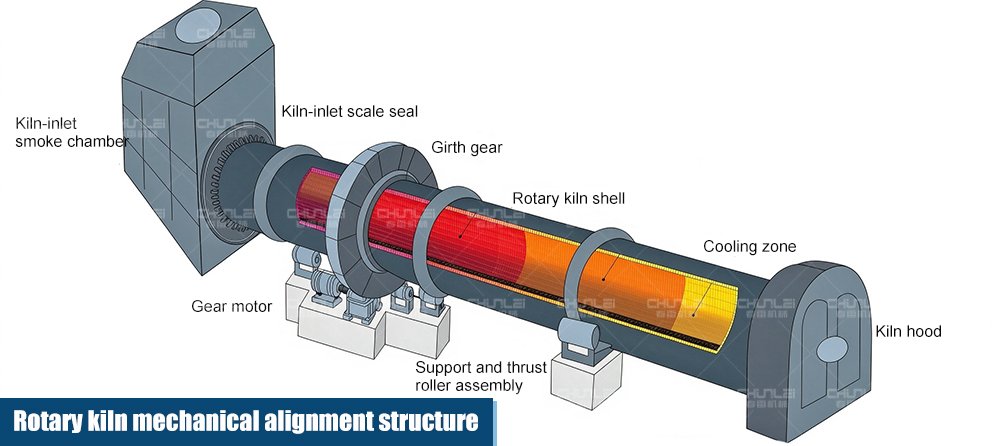
In simple terms, rotary kiln alignment refers to ensuring that the kiln shell, riding rings (tires), support rollers, and drive components maintain the relative positions and geometric relationships specified in the original design.
A properly aligned rotary kiln allows the support system to distribute the equipment load effectively, ensures smoother rotation of the kiln shell, and minimizes unnecessary mechanical stress.
Poor alignment of a rotary kiln can lead to the following issues:
Uneven loading on support rollers and riding rings.
Increased bearing temperatures and higher friction.
Greater equipment vibration and mechanical noise.
Higher energy consumption for the motor and drive system.
Premature wear of riding rings, support rollers, and gears.
Additional stress on the kiln shell and its refractory lining.
For operations such as cement production, lime calcination, or mineral processing, these issues directly impact equipment uptime and production costs.
It is important to note that rotary kiln alignment is not merely about ensuring the kiln shell rotates; rather, it is about guaranteeing that the entire support and drive system functions in a coordinated manner.
5 Common Rotary Kiln Alignment Issues
Rotary kiln alignment directly impacts the operational stability and service life of the equipment. Poor alignment can lead to uneven wear on support rollers, kiln tyre migration, bearing overheating, and abnormal gear wear—potentially resulting in equipment downtime.
Below are 5 common rotary kiln alignment issues and their corresponding solutions.
1. Kiln Axis Misalignment
Primary Causes:
Foundation settlement or installation deviations.
Displacement of support bases.
Structural deformation due to long-term operation.
Solution:
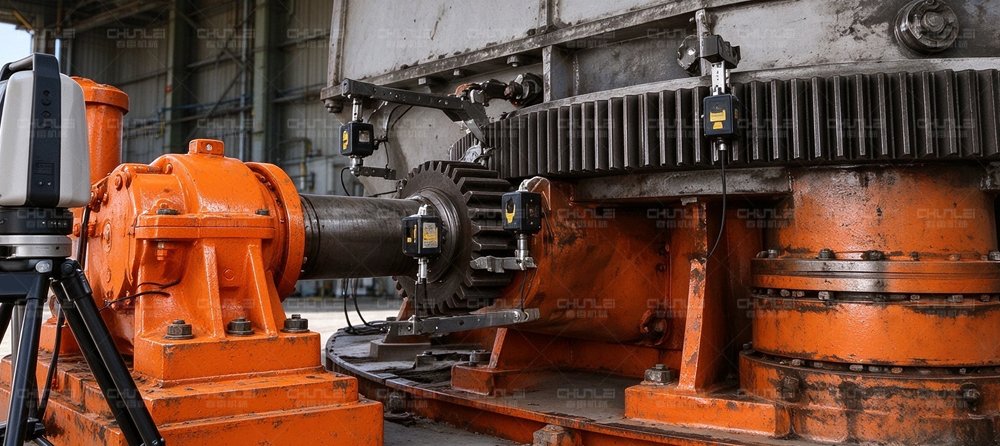
Use a laser alignment tool to check the positions of all support points; adjust based on the measurement results to ensure the kiln axis conforms to design specifications.
Examine contact patterns, surface wear, and temperatures to identify the root cause of uneven contact; perform adjustments or repairs as necessary.
4. Axial Movement Issues
Primary Causes:
Improper adjustment of the support rollers.
Abnormal inclination (slope) of the kiln installation.
Malfunctions in the thrust rollers or the hydraulic thrust system.
Solutions:
Check the angles of the support rollers, the condition of the thrust rollers, and the extent of axial movement to prevent excessive axial thrust on the kiln shell.
The large ring gear and the pinion gear are in poor mesh.
The motor and reducer axes are misaligned.
The transmission base is displaced.
Solution:
Check the gear meshing clearance, contact spots and shaft system alignment, and perform calibration in time.
How should the alignment of a rotary kiln be checked?
The accuracy of a rotary kiln’s alignment directly affects the stability of its operation. If the kiln’s alignment deviates significantly, it can lead to uneven loading on the support rollers, wear on the riding rings (tires), and vibration of the kiln shell; in severe cases, it may also increase the risk of damage to gears and bearings. Assessing the alignment of a rotary kiln requires more than just verifying whether the kiln shell forms a straight line; it necessitates a comprehensive evaluation that considers the riding rings, support rollers, the central axis, and the operational behavior of the kiln. Typically, this involves measuring the equipment’s central axis, inspecting the contact between the riding rings and support rollers, observing the kiln’s running trajectory, and monitoring load variations at various support points. If significant localized wear, uneven contact at the support rollers, or abnormal axial movement (drifting) of the kiln shell is detected, a thorough alignment check and timely adjustment are required. The key aspects to examine when checking the alignment of a rotary kiln are as follows:
Check items
Check method
Normal situation
Abnormal behavior
Kiln body center line
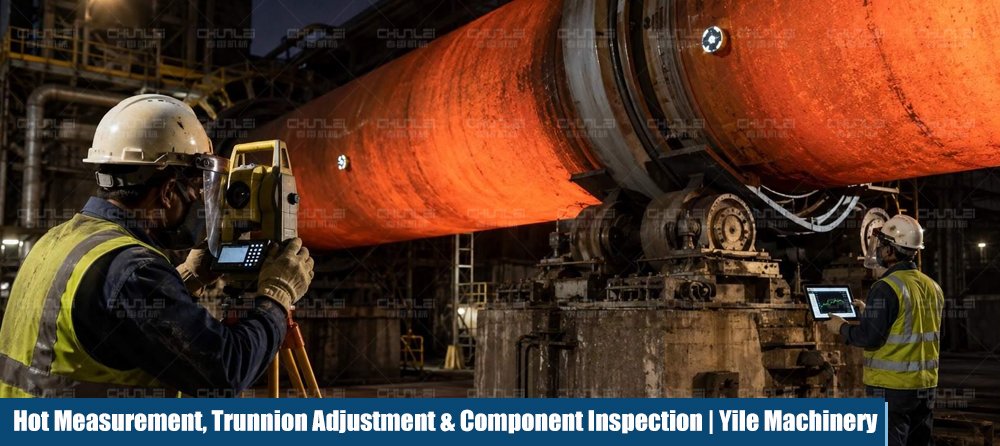
Use a laser aligner, theodolite or measuring tool to check the center position of each support point
Each support point meets the design axis requirements
The axis of the kiln body is offset and the center line is inconsistent
Tire position
Check the relative position and operating status between the wheel belt and the cylinder
The wheel belt runs smoothly without obvious deflection
Tire deviation, local wear or abnormal swing
Support wheel contact situation
Check the contact surface and contact marks between the supporting wheel and the tire belt
Even contact and reasonable force
Unilateral contact, local wear, uneven stress
Supporting roller axis
Measure the relative relationship between the supporting wheel axis and the designed position
Meet equipment installation and adjustment requirements
The supporting wheel is skewed and the left and right forces are inconsistent.
Kiln body radial runout
Use a dial indicator or special measuring equipment for testing
The jitter value is within the specified range of the equipment
The kiln body swings obviously during operation
Axial movement of kiln body
Observe the position changes of the tire belt relative to the supporting wheel and monitor the axial movement
Axial movement is stable and within the allowable range
The kiln body moves frequently or the amount of movement is abnormal.
Operating temperature and vibration
Use thermometer and vibration detector to check bearings and supporting parts
Temperature and vibration are within the normal operating range
Local temperature rise, abnormal vibration or noise
During inspection, keep the following points in mind:
Select appropriate measuring tools: Laser alignment systems are suitable for axis alignment, dial indicators can be used to check for runout, and temperature or vibration sensors help identify operational anomalies.
Consider both cold and hot conditions: Rotary kilns undergo thermal expansion during operation; therefore, alignment that is acceptable in a cold state does not guarantee it will remain within limits during hot operation.
Maintain regular records: Document the positions of support points, the contact status of support rollers, and any changes in temperature or vibration to help determine if the equipment is gradually drifting out of alignment.
Identify the root cause before making adjustments: Do not simply adjust support rollers upon observing wear or axial movement of the kiln shell; instead, investigate other potential factors such as foundation settlement, bearing condition, clearances at the riding rings (tires), and deformation of the kiln shell.
It must be emphasized that inspection and adjustment tasks should be performed by qualified professionals. Furthermore, any measurements taken while the equipment is in operation must strictly adhere to established safety protocols.
Common fault manifestations and possible causes of rotary kiln
Different alignment problems sometimes lead to similar fault manifestations. The following table can help equipment maintenance personnel conduct preliminary troubleshooting.
Symptoms
Possible Causes
Recommended Inspections
Uneven wear of support rollers
Poor alignment of support rollers or abnormal loading
Support roller positioning and contact status
Excessive axial movement
Misalignment of support rollers or malfunction in the axial control system
Support roller geometry and the axial control system
Abnormal gear noise
Poor meshing between gears (pinion and main gear)
Tooth backlash and tooth surface contact pattern
Excessive bearing temperature
Bearing damage, inadequate lubrication, or abnormal loading
Bearing condition and lubrication system
Abnormal vibration of the kiln/drum shell
Deformation of the shell or issues with the support system
Radial runout of the shell and support positioning
Localized high temperature on the shell
Damage to refractory materials or uneven heating
Infrared temperature measurement and inspection of refractory materials
It should be reminded that these phenomena are only fault warning signals and cannot be directly used as the final diagnosis result. After a problem is discovered, it is still necessary to confirm the cause through actual measurement and inspection.
How can alignment issues in a rotary kiln be prevented?
Rather than waiting for an alignment failure to occur before carrying out repairs, it is better to focus on proactive daily maintenance.
The following five recommendations can help reduce alignment-related problems in rotary kilns.
Establish a baseline for alignment data Once the equipment is installed or has undergone a professional alignment inspection, document the data—including the rotary kiln’s centerline, support roller positions, the condition of the riding rings (tires), and gear alignment—to serve as a reference for future inspections.
Monitor the operating status of support rollers Keep records of support roller positions, bearing temperatures, the axial movement of the riding rings, and contact patterns. Tracking changes in this data allows for the early detection of any irregularities.
Pay close attention to the thermal state of the equipment Uneven temperature distribution and damage to refractory materials can affect the geometric shape of the kiln shell. Therefore, the surface temperature of the kiln shell should be monitored regularly, with prompt investigation into any localized high-temperature areas.
Avoid arbitrary adjustments to mechanical components If the rotary kiln exhibits axial drift or unusual noise, do not immediately adjust the support rollers. First, identify the root cause, then develop a proper adjustment plan; otherwise, you risk creating more problems while attempting to fix the existing one.
Implement a scheduled alignment inspection plan The frequency of inspections should be determined based on the rotary kiln’s specific operating conditions, historical failure data, manufacturer recommendations, and maintenance requirements. A well-structured maintenance plan helps minimize unplanned downtime and extends the service life of mechanical components.
Rotary Kiln Refractory Lining FAQ
Q1: What is the primary function of the support rollers (trunnion rollers) for a rotary kiln? A: Support rollers are primarily used to bear the weight of the rotary kiln shell and the material inside it, while ensuring the kiln can rotate smoothly. The installation position, angle, and load distribution of these rollers directly affect the operational stability of the rotary kiln. Q2: Why do rotary kiln support rollers require periodic adjustment? A: Over long periods of operation, factors such as foundation settlement, roller wear, deformation of the riding rings (tires), and changes in equipment load can lead to uneven distribution of forces on the support rollers. If not adjusted in a timely manner, this can easily result in localized wear, vibration, and increased bearing temperatures. Q3: What are the consequences of improper adjustment of rotary kiln support rollers? A: Improper adjustment can lead to abnormal contact between the rollers and the riding rings, axial shifting (drift) of the kiln shell, and increased bearing loads. In severe cases, it can cause surface damage to the rollers and riding rings, disrupting the normal operation of the entire piece of equipment. Q4: How can one determine whether the load on rotary kiln support rollers is evenly distributed? A: This can be assessed by examining the contact patterns of each set of rollers, monitoring bearing temperatures, evaluating bearing loads, and observing operational vibrations. When necessary, professional instruments should be used to measure the forces acting on the rollers and relevant geometric parameters; visual inspection alone is insufficient. Q5: Which parameters are primarily adjusted when tuning rotary kiln support rollers? A: Key parameters include the center position of the rollers, their axial orientation, their inclination angle, and the contact interface between the rollers and the riding rings. Specific adjustment parameters should be determined by referring to the equipment design drawings and the technical requirements provided by the manufacturer. Q6: Why is it important to monitor the axial movement (drift) of the kiln shell when adjusting the support rollers? A: Adjusting the support rollers influences the axial movement tendency of the kiln shell. If the adjustments are not well-calculated, the kiln shell may continuously drift toward one end, increasing the load on the thrust rollers (retaining rollers) and potentially causing abnormal wear on both the thrust rollers and the riding rings. Q7: Should the adjustment of rotary kiln support rollers be completed in a single operation? A: It is not advisable to perform large, sweeping adjustments all at once. Typically, the equipment status must first be measured, followed by small, incremental adjustments based on any observed deviations. After each adjustment, it is essential to monitor the contact between the support rollers and the kiln, the movement of the kiln shell, and changes in load to avoid over-adjustment. Q8: Can severe wear on the surface of a support roller be resolved through adjustment? A: If the issue is merely minor, uneven contact, the position of the support roller can be adjusted accordingly. However, if the support roller exhibits significant grooving, cracks, spalling, or severe, uneven wear, adjustments alone will not suffice; the roller will generally require repair or replacement. Q9: Is high bearing temperature in a rotary kiln support roller related to roller adjustment? A: It is related, though not necessarily caused solely by improper adjustment. Uneven loading of the support rollers or misalignment of their axes can increase the load on the bearings. Furthermore, insufficient lubrication, bearing damage, or inadequate cooling can also lead to temperature increases; therefore, a comprehensive inspection is required. Q10: How can alignment deviations be prevented during the long-term operation of a rotary kiln? A: First, ensure high precision during the installation of the foundation, support rollers, and the kiln shell. Second, conduct regular inspections of the anchor bolts, support rollers, riding rings (tires), and bearings. Simultaneously, monitor the kiln’s vibration, temperature, and axial movement. Address any anomalies promptly to prevent minor deviations from escalating into serious mechanical failures.
Summary
Alignment issues in a rotary kiln may seem minor, but they cannot be ignored over the long term. Misalignment of support rollers, wear on the kiln tires (riding rings), or poor gear meshing can lead to equipment vibration and abnormal wear—potentially even disrupting normal production.
There are five common issues: deviation of the kiln’s central axis, inaccurate alignment of support rollers, shifting (wandering) of the kiln tires, deformation of the kiln shell, and improper meshing of the main drive gears.
Do not rush to make adjustments when problems arise; identifying the root cause is the critical first step. Because the various components of a rotary kiln work in close coordination, a failure in any single part can affect the operation of the entire system.
If your rotary kiln is experiencing similar issues, please contact us. We can help analyze the root causes and provide an appropriate solution.
Whether you operate a mineral processing plant, an alumina refinery, or a mining operation, you understand that the calcination process is crucial to product quality. An unsuitable rotary kiln is not only wasteful of materials, time, and money, b...
Chunlei Machinery, a professional rotary dryer manufacturer with over two decades of experience, is excited to announce the successful export of a 1800×12m Rotary Drum Dryer to the Philippines. This latest delivery underscores our position as a t...
Choosing the right rotary kiln is the foundation of a successful calcination project—whether you’re processing mining ores, cement clinker, lime, or alumina, the wrong kiln type can lead to low production efficiency, high energy waste, frequent e...
When selecting a rotary kiln, many customers view it simply as a large heating cylinder without fully understanding its operating mechanism. In reality, the basic principle is straightforward.Raw materials enter the kiln at the higher end, while ...
 Chunlei Rotary kiln