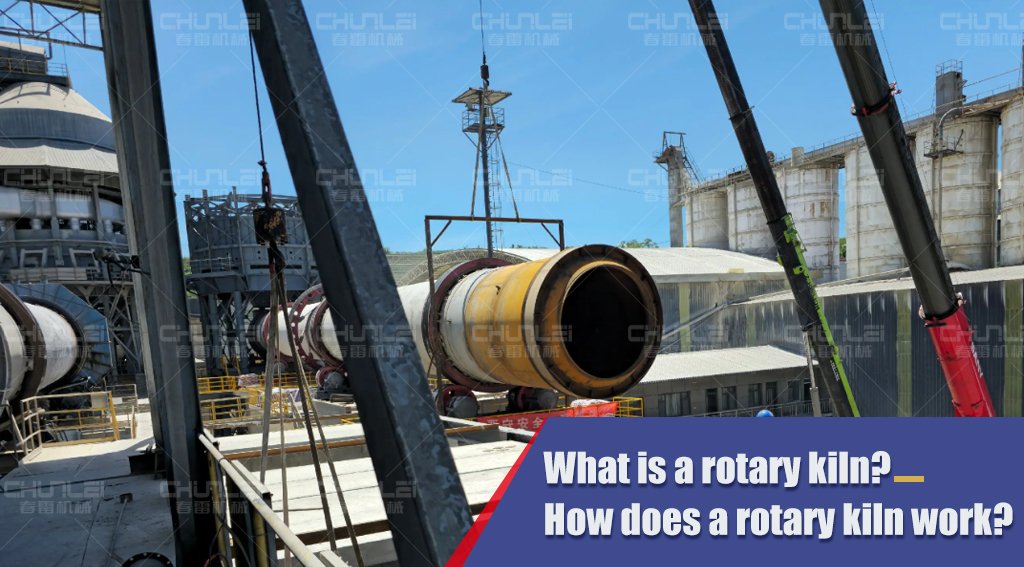
When selecting a rotary kiln, many customers view it simply as a large heating cylinder without fully understanding its operating mechanism. In reality, the basic principle is straightforward. Raw materials enter the kiln at the higher end, while the kiln body rotates continuously at a low speed. Due to the kiln’s inclination, the material gradually moves toward the discharge end under the combined influence of rotation and gravity, undergoing continuous heating in the process.
Depending on the specific material and process requirements, rotary kilns can be used for drying, preheating, calcining, roasting, reduction, or sintering. The quality of the final product depends on the interplay of various parameters, including temperature, fuel type, material residence time, feed particle size, kiln rotation speed, airflow, heat transfer efficiency, and the condition of the refractory lining.
For instance, simply increasing the burner temperature does not necessarily improve calcination results. If the material’s residence time in the reaction zone is insufficient, under-burning may occur despite high temperatures.
Conversely, excessively high temperatures or prolonged residence times can lead to over-burning, fuel wastage, and damage to the refractory lining.
Therefore, when selecting a rotary kiln, one must consider factors such as the material feeding method, heat transfer characteristics, and the required temperature and residence time, rather than focusing solely on “maximum temperature” and “processing capacity.”
Rotary Kiln Working Principle
To understand the rotary kiln, we can trace the material’s path:
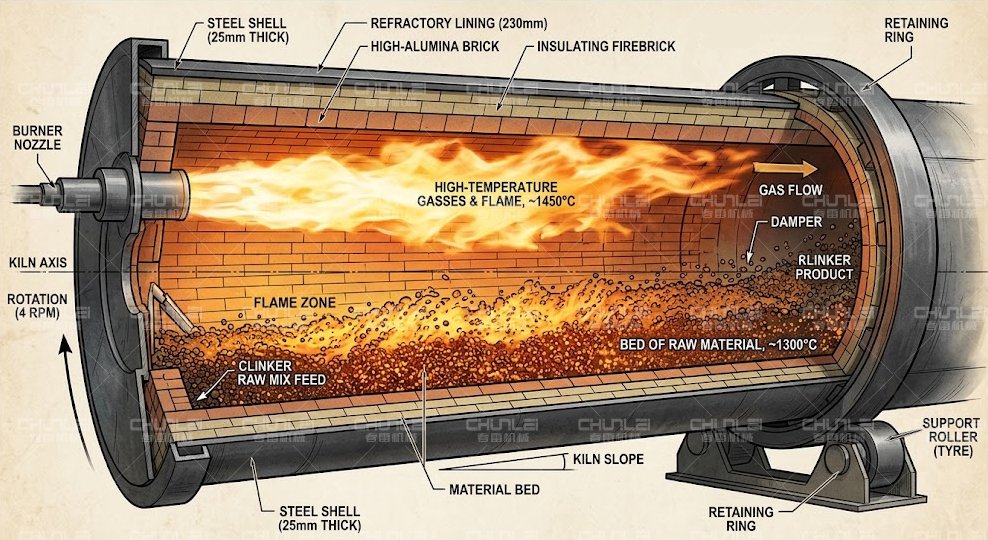
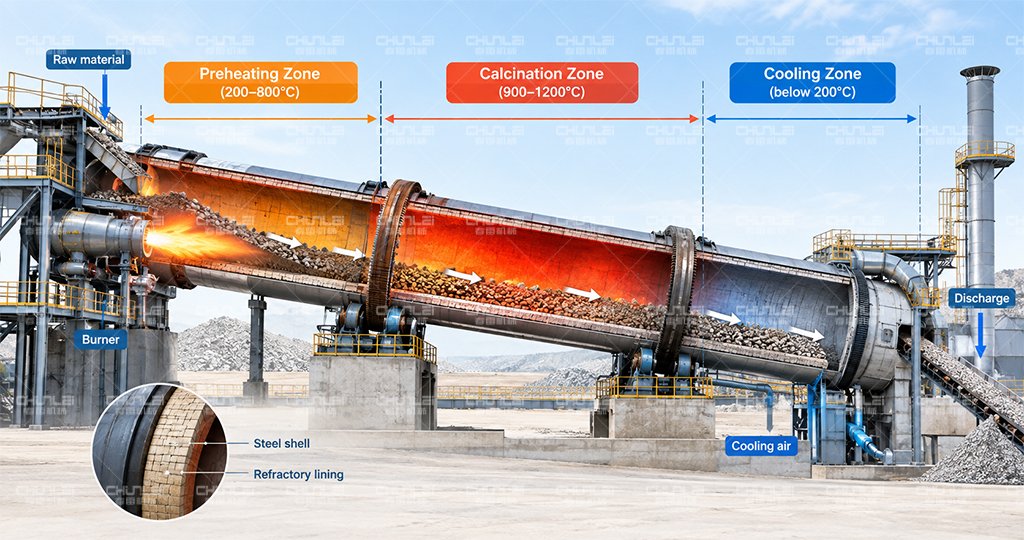
Rotary kilns are typically installed at an incline, with the kiln body rotating continuously.
As the kiln rotates, the material is constantly turned, lifted, and tumbled while gradually moving toward the lower end.
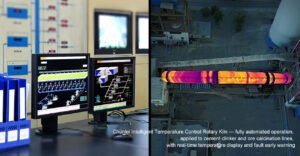
Heat is transferred to the material inside the kiln primarily through radiation, convection, and conduction.
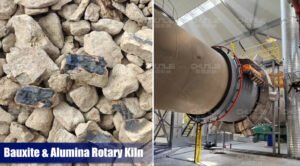
Different materials require different operating temperatures. For instance, the process temperature for some rotary kilns handling laterite nickel ore is approximately 800–1200°C, whereas the expansion zone temperature for lightweight expanded clay aggregate (LECA) may reach 1100–1200°C. These figures cannot be applied as universal settings for all projects; actual temperatures must be determined based on material properties and specific reaction requirements. maintain stable temperatures, and transform your bauxite/alumina into the high-quality product your buyer needs.
Key Components of a Rotary Kiln
A rotary kiln is not merely a single kiln body; it is a complete system composed of various mechanical and thermal components.
1. Rotary Kiln Shell
The kiln shell is the primary cylindrical steel structure of the rotary kiln.
The diameter and length of the shell influence the internal effective volume and the material residence time.
However, note that:
A larger kiln shell does not necessarily guarantee better process results.
Shell dimensions must be determined based on a comprehensive assessment of processing capacity, material properties, heating method, target temperature, and residence time.
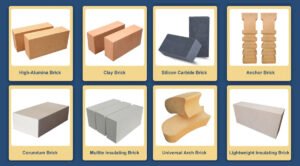
2. Refractory Materials
The refractory lining serves primarily to protect the steel kiln shell, enabling it to withstand high temperatures, chemical erosion, and material abrasion.
This component is often overlooked by customers.
If the refractory material is damaged, more heat is transferred to the steel shell, leading to increased heat loss and potentially causing localized overheating of the shell.
Selection of refractory materials depends on:
Operating temperature
Chemical properties of the material
Degree of abrasion
Kiln atmosphere
Chemical corrosion
Heating method
Service life requirements
The most expensive refractory material is not necessarily the best; the choice must align with actual operating conditions.
3. Burner or Heating System
The burner supplies the heat required for the rotary kiln.
Common heat sources include:
Coal
Natural gas
Fuel oil
Biomass fuel
Electric heating
Electromagnetic heating
Different heating methods impact fuel costs, temperature control, emission requirements, and the overall plant system configuration.
4. Drive System
The drive system is responsible for maintaining the stable rotation of the kiln shell.
Kiln speed is critical, as it directly affects material residence time.
If the speed is too high, material may be discharged before the required reactions are complete.
If the speed is too low, the residence time may be excessive, increasing fuel consumption and potentially causing over-burning.
5. Support Rollers and Riding Rings
Large rotary kilns typically support the entire shell using a system of riding rings and support rollers.
These components must bear the immense weight of the kiln shell, refractory lining, and material, while ensuring stable, continuous rotation.
6. Feed and Discharge Systems
The feed system is responsible for steadily introducing raw materials into the kiln. Stable feed input is crucial, as significant fluctuations in feed rate or material properties will cause corresponding changes in the thermal load within the kiln.
The discharge end is responsible for removing the calcined material and transporting it to downstream processes such as cooling, grinding, screening, or other operations.
7. Preheaters and Coolers
Depending on the specific process, rotary kilns can be equipped with preheaters and coolers.
The preheater utilizes high-temperature flue gas to preheat the material before it enters the kiln.
The cooler reduces the temperature of the calcined product while recovering a portion of the heat for reuse in the combustion system or the preheating stage.
Therefore, in actual projects, the rotary kiln should be viewed as an integrated thermal system rather than as an isolated piece of equipment.
How does a rotary kiln work?
The working principle of a rotary kiln can be simply understood as follows:
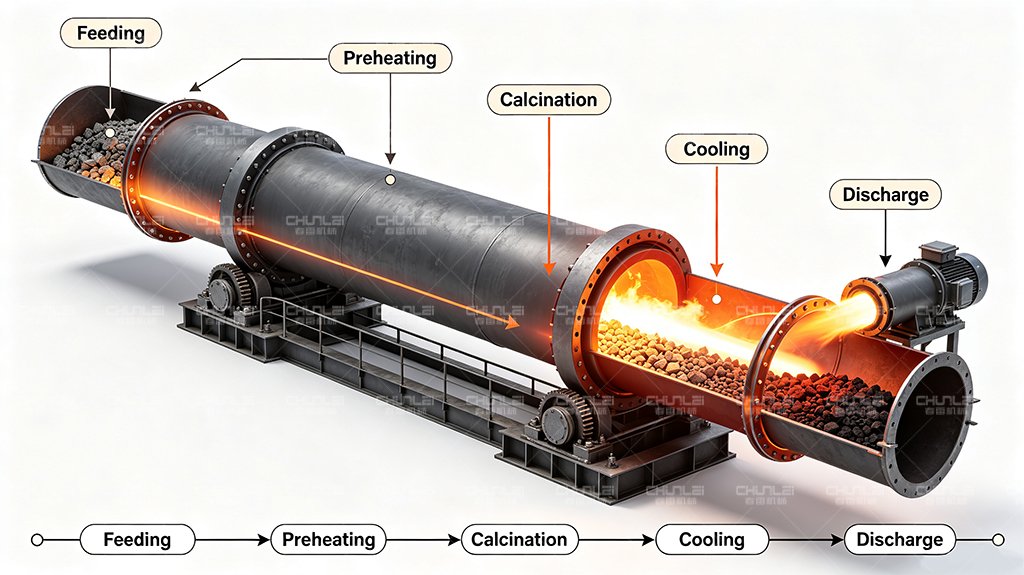
Raw materials enter the kiln at the elevated end and move toward the lower end while continuously tumbling within the inclined, rotating vessel. As they move, they absorb heat from the burner, undergoing successive stages of preheating and calcination (or roasting), before finally discharging from the lower end into a cooling system.
In actual operation, factors such as temperature, kiln speed, material residence time, fuel usage, and thermal efficiency must be carefully balanced; one cannot simply aim for higher temperatures or faster production rates in isolation.
Operational Stage
Main Process
Key Control Factors
Feeding
Continuous entry of raw materials into the kiln
Feed rate, moisture content, particle size
Preheating
Gradual elevation of material temperature using hot flue gas
Flue gas temperature, heat exchange efficiency
Calcination
Dehydration, decomposition, oxidation, or other reactions occurring in the high-temperature zone
Temperature, residence time, fuel, atmosphere
Cooling
Cooling of high-temperature products and partial heat recovery
Cooling efficiency, waste heat recovery
Discharge
Discharge of processed material from the kiln outlet
Simply put: the material determines the process, the process determines the temperature and residence time, and temperature, fuel, and thermal efficiency collectively determine the final calcination result.
What factors determine the operational performance of a rotary kiln?
The operational performance of a rotary kiln depends on more than just the equipment itself. Material properties, temperature control, rotational speed, feed rate, fuel supply, and ventilation conditions all influence calcination quality, output, and energy consumption. In actual production, these parameters are typically adjusted based on material characteristics and the target product, rather than focusing on a single metric in isolation.
Material properties: Particle size, moisture content, composition, and calcinability affect heat transfer and reaction rates.
Kiln temperature: Excessively low temperatures can lead to incomplete calcination, while excessively high temperatures may cause over-burning, ring formation, or increased energy consumption.
Rotational speed: Affects the material’s residence time and tumbling action within the kiln.
Feed rate: Excessive feeding can lead to material accumulation and incomplete reactions, while insufficient feeding reduces equipment utilization.
Fuel and combustion: Stable fuel supply and efficient combustion help maintain uniform kiln temperatures.
Ventilation conditions: Proper airflow facilitates combustion, heat transfer, and flue gas exhaust.
Equipment sealing and insulation: Minimizing air leakage and heat loss is crucial for reducing energy consumption and ensuring stable operation.
Operation and maintenance: Factors such as kiln alignment, the condition of support rollers, and refractory brick wear affect long-term operational stability.
Many operators fall into the misconception that higher temperatures guarantee more thorough calcination. In reality, this is not the case. A rotary kiln requires an optimal temperature profile rather than a simple pursuit of maximum heat. If the temperature is too low, the material fails to react sufficiently; if it is too high, it can lead to over-burning, material agglomeration, and increased wear on refractory materials, while also driving up fuel consumption and operating costs. Crucially, the optimal temperature varies depending on the material; adjustments must also account for factors such as residence time, feed rate, particle size, fuel type, and the kiln atmosphere.
Temperature Condition
Potential Issues
Key Areas of Focus
Temperature too low
Incomplete reaction or calcination; unstable product quality
Improve heat utilization and thermal insulation
Optimal temperature
Complete reaction; stable product quality and output
Maintain a stable temperature profile
Temperature too high
Over-burning, agglomeration, increased energy consumption, accelerated refractory wear
For a rotary kiln, “hotter is not necessarily better”; instead, the temperature must be matched to the material properties, reaction requirements, and residence time. An optimal operating state is one that achieves stable product quality and low energy consumption at a reasonable temperature, while still meeting the necessary calcination standards.
Rotary Kiln Fuel Consumption: What Should You Really Look At?
When evaluating rotary kiln energy consumption, many customers’ first reaction is to ask, “How much fuel is consumed per ton of product?” However, accurately assessing fuel consumption requires looking beyond a single figure; it is best to consider energy consumption per unit of product, product quality, output, and thermal efficiency in conjunction.
Key factors influencing fuel consumption include:
Material moisture content: Higher moisture levels require more heat for initial evaporation.
Material properties: Different minerals have varying decomposition temperatures and heat requirements for reactions.
Feed particle size: Excessively large particles can slow down heat transfer and reaction rates, increasing heat demand.
Calcination temperature: Higher temperatures are not always better; excessive heat leads to energy waste.
Residence time: Insufficient time may result in incomplete calcination, while excessive time increases unproductive heat loss.
Kiln insulation: The condition of the refractory lining and the kiln shell’s heat dissipation directly affect heat loss.
Combustion efficiency: The completeness of fuel combustion determines how much input heat is effectively utilized by the material.
Heat exchange efficiency: Optimized heat exchange between the flue gas and the preheating/calcination zones allows for better waste heat utilization.
Kiln speed and feed rate: Variations in kiln speed and feed rate alter material residence time and heat consumption per unit of product.
System integration: Equipment such as burners, fans, preheaters, and coolers must operate in coordination.
Don’t just look at…
What you should really look at is…
Total fuel consumption
Fuel consumption per unit of product
Merely pursuing low temperatures
A temperature profile that ensures product quality
Just the burner
Combustion efficiency + heat exchange efficiency
Just the rotary kiln itself
The heat balance of the entire thermal system
Just output
Output + calcination quality + energy consumption
How to improve the thermal efficiency of rotary kiln?
1. Stabilize the moisture content of raw materials
If the feed moisture content varies greatly, the kiln will need to constantly adjust the heat.
Stable feed conditions help keep temperatures stable.
2. Reduce unnecessary air leakage
If the kiln head and kiln tail are not properly sealed, external cold air will enter the system, increasing the amount of gas that needs to be heated and exhausted.
So the sealing system, although inconspicuous, is very important to thermal efficiency.
3. Optimize the burner
The burner needs to ensure stable combustion and reasonably distribute heat to the target reaction zone.
Simply adding more fuel will not solve all temperature problems.
4. Maintain refractory lining
After the refractory material is damaged, more heat will be transferred to the steel shell and lost to the outside.
Therefore, regular inspections of refractory materials can prevent small problems from developing into serious shutdowns.
5. Recovery of waste heat
Both high-temperature flue gas and high-temperature finished products carry a lot of heat.
Depending on the specific process, this heat can be used for:
Raw material preheating
Combustion air preheating
Drying
steam production
Other process heating
Rotary Kiln Refractories: Why Are They So Important?
Refractory lining is not merely a layer of “thermal insulation.” In reality, it must withstand a combination of: High temperatures + Thermal shock + Abrasion + Chemical attack Different materials and temperature zones impose varying requirements on refractory materials. For instance, the refractory materials selected for a lime rotary kiln may not be suitable for cement clinker production, alumina calcination, or high-temperature roasting.
Common Refractory Issues
Problem
Possible Cause
Rapid lining wear
Material abrasion or refractory mismatch
Cracking
Thermal shock or mechanical stress
Localized high temperature on the kiln shell
Lining damage or excessive heat loss
Localized high temperature
Unstable flame or damage to the refractory layer
Frequent shutdowns
Refractory failure or mechanical malfunction
Do not select refractory materials based solely on the maximum operating temperature. The chemical properties of the materials, the degree of abrasion, and the kiln atmosphere are equally important.
Comparison of Rotary Kilns with Other Thermal Processing Equipment
Different types of thermal processing equipment vary significantly in their operating principles and application scenarios; one cannot simply assume that higher operating temperatures equate to more advanced technology. Selection should be based primarily on material properties, processing capacity, heating method, residence time, and final process requirements.
Equipment
Primary Operating Method
Suitable Materials
Key Features
Common Applications
Rotary Kiln
Material moves continuously through a rotating kiln body while being heated
Ores, limestone, clay, cement clinker, etc.
Continuous production; high throughput; adjustable temperature and residence time
Calcination, roasting, drying, heat treatment
Rotary Furnace / Rotary Calciner
Similar to a rotary kiln; performs heat treatment via rotation and heating
Minerals, chemical raw materials, industrial solid waste, etc.
Thorough material agitation; high adaptability
Calcination, roasting, pyrolysis
Shaft Kiln
Material moves downward via gravity within a vertical kiln body
Granular limestone, etc.
Relatively compact structure; suitable for materials of specific particle sizes
Lime calcination
Tunnel Kiln
Material is placed on kiln cars and moves continuously through different temperature zones
Ceramics, refractory materials, bricks, etc.
Stable temperature zones; suitable for continuous production
Ceramics, bricks/tiles, refractory materials
Fluidized Bed Furnace
Gas flow fluidizes and heats fine granular material
Powders, fine granular materials
Rapid heat transfer; uniform temperature
Drying, roasting, chemical heat treatment
Resistance Furnace
Heat is provided directly via electrical resistance heating
Small batches or materials requiring precise temperature control
Precise temperature control; however, energy consumption and investment costs require careful consideration for large-scale operations
Laboratory use; heat treatment of metals and materials
Rotary Dryer
Uses a hot gas stream to evaporate moisture from the material
Ores, sand and gravel, concentrates, etc.
Primarily for dewatering; high-temperature reactions are not the main focus
Mineral drying; sand and gravel drying
If the process requires materials to undergo continuous heating over an extended period—while simultaneously controlling temperature, material agitation, and residence time—a rotary kiln is generally more suitable. However, for applications such as drying, rapid heating of powders, or specific small-batch heat treatments, other types of equipment should be selected based on the specific process requirements.
What determines the dimensions of a rotary kiln?
Bigger is not necessarily better when it comes to rotary kiln dimensions; size is primarily determined by processing capacity, material properties, feed moisture content, target temperature, residence time, and the specific heat treatment process. Specifically:
Processing capacity determines the basic specifications of the kiln body;
Material particle size, density, and moisture content affect the effective volume;
The temperature and residence time required for calcination, roasting, or drying further determine the ratio of the kiln’s diameter to its length.
Therefore, equipment selection should be based on calculations involving the specific material and process conditions, rather than simply choosing a standard model based on production capacity.
How do you select the right rotary kiln?
Selecting the right rotary kiln requires looking beyond just production output and equipment dimensions; the material and process are the critical factors. Evaluation typically covers the following aspects:
① Processing capacity: Determine the tonnage of material to be processed per hour; ② Material characteristics: Include particle size, moisture content, density, viscosity, and the presence of corrosive components; ③ Heat treatment requirements: Clarify whether the process is drying, calcination, or roasting, as well as the required temperature and residence time; ④ Fuel and thermal efficiency: Select an appropriate heating method based on available fuels such as coal, natural gas, or diesel; ⑤ Kiln dimensions: Determine the diameter and length based on production output, material residence time, and thermal load. In short, first determine “what material is being processed, the quantity, and the required heating level,” and then determine the appropriate rotary kiln model and specifications.
Common Mistakes When Purchasing a Rotary Kiln
Focusing solely on processing capacity The nominal processing capacity of the equipment does not guarantee that this output rate can be achieved with every type of material.
Focusing solely on maximum temperature The ability to reach high temperatures does not necessarily mean the kiln is suitable for your specific material.
Overlooking residence time Even with sufficient temperature, inadequate residence time can still result in under-firing.
Choosing only the cheapest fuel Fuel selection should be based on a comprehensive assessment of thermal efficiency, storage and transport, environmental impact, and maintenance costs.
Focusing only on the kiln body rather than the entire thermal system Components such as the burner, kiln body, refractory lining, preheater, cooler, exhaust system, and waste heat recovery unit all influence final energy consumption.
Common Rotary Kiln Issues and Prevention Methods
Issue 1: Inadequate Product Calcination Possible causes:
Insufficient temperature
Short residence time
Excessive feed rate
Poor heat transfer efficiency
High raw material moisture content
Recommendation: Check the overall heat balance first rather than immediately increasing fuel input.
Issue 2: Product Over-burning Possible causes:
Excessive temperature
Excessive residence time
Uneven material distribution
Localized high temperatures
Solution: Usually involves improving process control rather than simply lowering the overall kiln temperature.
Issue 3: Excessive Fuel Consumption Key areas to check:
Raw material moisture content
Flue gas temperature
Air leakage
Burner condition
Refractory condition
Heat recovery system
Combustion air
Issue 4: Short Refractory Service Life Do not immediately assume the issue lies with the quality of the refractory material.
Check for:
Suitability of the refractory type
Installation quality
Thermal cycling
Material abrasion
Chemical attack
Flame positioning
Localized overheating
Sometimes the root cause is improper operating conditions rather than the refractory material itself.
FAQ
Q: What are rotary kilns primarily used for?
A: Rotary kilns are primarily used for continuous thermal processing, such as drying, calcining, roasting, reduction, and sintering. Specific applications depend on the material properties and the physical or chemical reactions required.
Q: What operating temperatures are typically required for rotary kilns?
A: There is no single temperature applicable to all materials.
Different materials require different temperature profiles. For example, some processes involving laterite nickel ore operate at approximately 800–1200°C, while the expansion zone for lightweight aggregates may reach 1100–1200°C.
Actual operating parameters for a project should be determined based on material properties and process testing.
Q: How is material residence time controlled in a rotary kiln?
A: Residence time is primarily influenced by the kiln’s length and diameter, inclination angle, rotational speed, feed rate, material particle size, and the dynamics of material movement.
Therefore, when adjusting the kiln speed, one must simultaneously monitor production output and the degree of calcination.
Q: What types of fuel can be used in rotary kilns?
A: Depending on the equipment design, the following fuels can be used:
Coal
Natural gas
Fuel oil
Biomass
Electric heating
Electromagnetic heating
The actual choice depends on local fuel availability, energy costs, environmental regulations, and temperature control requirements.
Q: Why are rotary kiln refractory materials prone to damage?
A: Common causes include unsuitable refractory selection, thermal shock, material abrasion, chemical erosion, installation issues, direct flame impingement, and localized overheating.
Therefore, when selecting refractory materials, one must consider the actual operating environment, not just the temperature rating.
Summary
The selection and operational performance of a rotary kiln ultimately depend on material characteristics, throughput, temperature requirements, and the specific process flow. No single model suits every project. If you are planning a drying, calcining, or roasting project, please contact us with details regarding your materials, production capacity, and process requirements; CHUNLEI can assist you in selecting the right rotary kiln solution.
Many cement plants undoubtedly face a common challenge: frequent downtime caused by damaged refractory materials. You are surely well aware that the rotary kiln lies at the very heart of the entire production process. It is within this vessel tha...
If you operate a cement, mining, lime, or metallurgical calcination plant, you’ve likely been struggling with this problem for years: the temperature in your rotary kiln is constantly fluctuating. When temperatures are too high, fuel is wasted; w...
If you’re running a lime production line, you know the stress of flue gas control all too well. Mess up O₂, CO, NOx, or SO₂ levels, and you’re facing fines, shutdowns, or even damaged kiln equipment — not to mention wasted fuel and inconsistent l...
Whether you operate a mineral processing plant, an alumina refinery, or a mining operation, you understand that the calcination process is crucial to product quality. An unsuitable rotary kiln is not only wasteful of materials, time, and money, b...
 Chunlei Rotary kiln